
By Terry Sherwood
Homage is a dangerous game in cinema. Pay too little respect to the classics and you lose their spirit; pay too much and you risk producing little more than a second-hand imitation. With Brute 1986, director Marcel Walz and writer Joe Knetter return to the savage territory of their previous film, trading the sun-baked brutality of seventies backwoods horror for the hairspray, leather and neon-soaked excess of the eighties slasher. The result promises a delirious collision of glam metal, grindhouse nastiness and old-fashioned cinematic carnage in which this works has it moments.
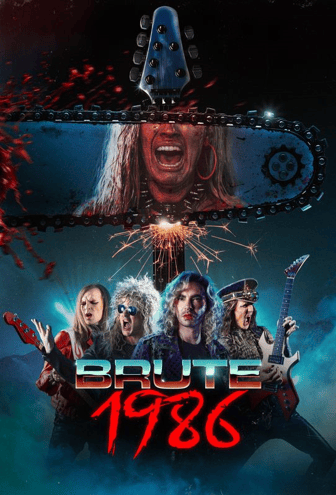
Following the events of Brute 1976, the sequel jumps forward a decade to introduce Leather Kobra, a glam-metal band preparing to shoot a music video in an abandoned Western town. It is hardly the most reassuring location for a production crew, particularly when the surrounding territory has become the hunting ground of the deranged Birdy family. Before long, the band’s rock-and-roll ambitions collide with the family’s appetite for violence, transforming a routine video shoot into a nightmare. Metal music is not stranger to this treatment of links with murder. The best for me is Heavy Trip at its sequel Heavier Trip with a Finnish metal band getting involved with when a reindeer carcass in a slaughterhouse gets stuck in an industrial meat grinder, and the sound inspires the band to write and their first original song and stardom. Not the same at Brute 1986 but the its in the same arena if not arena rock.
This work brings to mind the American slasher, when filmmakers took then then novel isolated location, a collection of questionable decisions and a suitably unhinged killer could provide the foundations for ninety minutes of cinematic mayhem. Walz and Knetter have openly embraced the decade’s horror heritage, drawing inspiration from such films as Friday the 13th, Maniac and A Nightmare on Elm Street 4. Many of which are actually name checked in the film itself at moments.
Where Brute 1976 looked towards the rural depravity of The Texas Chain Saw Massacre and The Hills Have Eyes, its successor appears determined to turn the clock forward without abandoning the franchise’s taste for grotesque violence. The change in decade offers a fresh aesthetic vocabulary: big hair, spandex, leather jackets, theatrical makeup and a soundtrack designed to accompany the slaughter with an appropriately thunderous guitar riff. Original music from Swedish hard-rock outfit CRAZY LIXX further reinforces the production’s commitment to its musical setting.
This combination of music and murder could prove the sequel’s most distinctive asset. Eighties horror was frequently excessive, occasionally ridiculous and rarely embarrassed by either quality. Like snakes in genitals, the good girl who becomes pregnant and ends up being The Final Girl . The crass manager who delivers wisdom about the “taste of lovers” right in line with a passage I read in Tommy Lee’s biography Tommy land Its villains could become larger than life, its violence increasingly inventive and its visual style gloriously tasteless.
The Birdy family like the “Firefly” family from Rob Zombie’ s House of 1000 Corpses and The Devils Rejects remains central to that promise. Rather than relying exclusively on conventional masked-killer imagery, the franchise has established a grotesque identity through its collection of disturbing faces and murderous personalities. The original film’s distinctive creature designs and practical gore helped distinguish its familiar backwoods premise from a straightforward exercise in nostalgia. The sequel has an opportunity to build upon that foundation, giving its antagonists a new decade’s worth of visual perversity while maintaining the unpleasant, almost folkloric menace that made their predecessors memorable.
The returning cast includes Dazelle Yvette, Sarah French and Gigi Gustin, alongside Tokio Hotel frontman Bill Kaulitz, Pancho Moler and Lew Temple. Their presence suggests a production comfortable with the intersection of horror, cult celebrity and performance. In a story centred on a band manufacturing an image for the camera, that intersection could become particularly effective: the musicians are selling an illusion of rebellion, only to encounter a family for whom violence is not a stage act. One of the best moments i have seen in any slasher and its totally not expected is a moment towards the end of the film with Dazelle Yvette as Mama Birdy and Sarah French as Sunshine. No soundtrack, real emotion of loss and parental guilt .
Of course, nostalgia alone cannot guarantee a successful slasher. The danger with any period homage is that costumes, soundtrack choices and familiar references become substitutes for suspense, character and genuine invention. Here you get a version of Leatherface on the road at dusk. Eighties iconography is instantly recognisable, but the best exploitation films understood how to use their outrageous surfaces to sustain tension and provoke discomfort. Brute 1986 will need more than a generous supply of fake blood and guitar solos to establish an identity of its own.
Nevertheless, the creative team’s willingness to embrace the period’s excess is encouraging. Walz and Knetter are not promising restrained psychological horror; they are aiming for an unapologetic collision of heavy metal and splatter cinema. For audiences who enjoy their slashers loud, lurid and deliberately outrageous, that approach is part of the attraction.

