
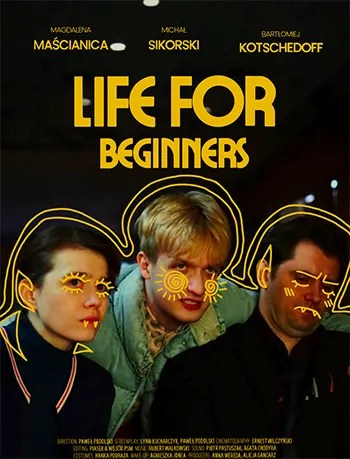


By Terry Sherwood
There’s something almost whimsical in how this polish film titled Life for Beginners in English stumbles onto a truth most films wouldn’t dare touch with a straight face: that a vampire working in a care facility keeping her hunger in careful check and a person nearing the end of their life are, in their own peculiar ways, doing the same quiet work. Both are managing appetites and absences the rest of us would rather not look at directly the slow withdrawal from the world, the isolation that settles in no matter how many people visit, how many flowers arrive, how many straws get unwrapped at a bedside. You are trapped in a world of loneliness
Life for Beginners takes the most overworked monsters in cinema besides the zombie and the serial killer — the vampire, dragged through a century of capes, castles, and brooding immortals and relocated her to the most unglamorous setting imaginable: a Polish retirement home, all linoleum floors and fluorescent lighting. This vampire, Monia (brilliant, understated Magdalena Maścianica), isn’t seducing anyone in a moonlit garden. She’s working a Night shift, quietly feeding on residents already standing at death’s threshold, treating predation as a kind of palliative care.
It’s a small, perverse genius of a premise, and the film mines it for a humor that is less about jokes than about incongruity. The image that will likely follow this film into whatever cult afterlife it earns is Monia’s refrigerator stocked not with the usual domestic clutter but with neatly arranged blood bags, sipped through a straw like she’s working through a bubble tea order. There’s something very European about this gag, actually with the banality of appetite contrasted with food for many is ritual, a gathering cultural place to be celebrated. It recalls less the Gothic tradition than a kind of deadpan Eastern European stoicism, where horror and domesticity sit at the same kitchen table without apparent contradiction.
The film is smart enough to know this conceit alone won’t sustain ninety minutes, so it complicates Monia’s careful arrangement with two intrusions. The first is Czarek (Michał Sikorski), grandson of the home’s most cantankerous female resident, who stumbles onto her secret and becomes entangled with her in a push-pull of suspicion and tenderness that never quite curdles into the romantic-comedy obviousness it could have. The second, more interesting complication is Mirek (Bartłomiej Kotschedoff), a rival vampire whom Monia turned as is now responsible for whose hunger has none of Monia’s discretion and whose centuries of existence have worn him down to something closer to despair than menace. He has come to asked for his release as only she can give him gives the film an unexpected current of melancholy beneath its comic surface, a reminder that eternal life, stripped of romance, just looks like exhaustion.
A stunning group of actors with some very funny lines and moments are within this work. Unlike the more recent Maggie Gyllenhaal’s The Bride which was over the top Bonnie and Clyde/ Wild at Heart look at romance of the dead, this work gets right into your heart lining especially then ending
Ana Lily Amirpour’s A Girl Walks Home Alone at Night, that black-and-white Iranian American fever dream about a robe clad vampire skateboarding through a ghost town, picking off men who deserve it. Both films share the same essential heresy stripping the vampire of her gothic theatrics and setting her loose in a landscape of quiet loneliness, where feeding becomes less a spectacle than a private, melancholy routine. Amirpour’s Girl haunts empty streets and oil derricks the way Monia haunts hallways and a humming refrigerator; both women feed with a kind of moral selectivity, choosing prey the world has already written off predators, in the Girl’s case, the dying, in Monia’s — as if the act of killing could still be reconciled with being good. And in both films, romance arrives sideways, almost accidentally, two solitary creatures recognizing in each other a shared fluency in isolation before either admits to wanting company at all.
Visually fangs appear exactly once, almost as a wink to the audience expecting them. This is, refreshingly, not Roman Polanski’s The Fearless Vampire Killers, but something more as it its shot cheaply, performed sincerely, and assembled with the kind of low-budget ingenuity that European genre cinema does so well when it isn’t trying to imitate Hollywood. Make no mistake this is brilliant, thoughtful at times whimsical filmmaking at is best
What elevates Life for Beginners above novelty is its genuine warmth toward its elderly cast. The retirement home residents aren’t props for the young leads’ romance; they’re given color, personality, do mischief, and in one gloriously unruly sequence involving a bonfire organized in open defiance of facility rules to stop a curse. It’s a strange thing to find tucked inside a horror-comedy, but it’s also what gives the film its heart without being overly sentimental.
Life For Beginners screened as part of Raindance Film Festival 2026.

