
By Terry Sherwood
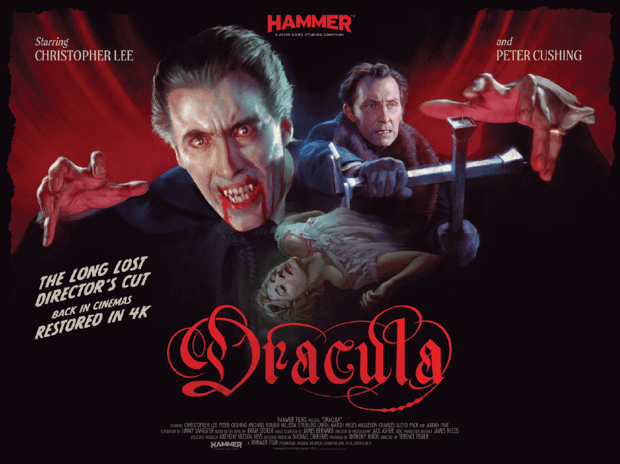
There are films that belong to their period, and then there are films that seem to create a period of their own. Terence Fisher’s Dracula (1958) or Horror of Dracula in North America, produced by Hammer Films and starring Christopher Lee and Peter Cushing, is one of them. More than six decades later, the new 4K restoration does something rather remarkable: it doesn’t simply make the film look better. It allows you to see the film anew.
Many have seen the picture before, read about even with the previous incarnations of it this is something to see. Considering what was going on in with the character of Dracula with the comedic undertones, and Bela Lugosi version being what was all the audience has, you can appreciate how revolutionary this was.
The detail in these images is extraordinary. The colour is vivid without destroying the character of the original photography, and for me the greatest revelation is how much there is to discover in the backgrounds of the frame. Hammer’s sets, which could sometimes appear merely atmospheric in older presentations, suddenly become environments. There are objects, textures, furnishings and architectural details everywhere. The famous Hammer claustrophobia is enhanced rather than diminished by the increased resolution. I noticed this in the Blu-ray of The Evil of Frankenstein with red vials of bubbling liquid and blood showing more the lab moments. You get more blood on the hands and clothes in this one as well that I noticed for the first time.
Harker’s first entrance into Dracula’s castle is a particularly striking example. In 4K you can see the black curtains masking the walls and creating the illusion of greater depth. What might once have registered simply as darkness now reveals itself as a piece of studio craftsmanship. The effect is wonderfully theatrical: Hammer isn’t hiding the fact that this is a constructed environment; it is using the limitations of the studio to create something larger than the physical space actually available.
That discovery runs throughout the picture. The sets are wonderfully cluttered with fascinating objects, furniture and Gothic detail. Rather than feeling empty, the interiors feel inhabited. The increased resolution makes you want to stop and examine them.
The lighting is perhaps even more impressive. Fisher and cinematographer Jack Asher understood that colour could be used almost as dramatically as dialogue. There are vivid splashes of colour against darkness, but there are also wonderfully controlled shafts and pools of light.
One moment particularly struck me anew: Lucy running with Tania toward her grave. For an instant, Lucy’s face appears almost isolated in a pool of light. The effect is fleeting, but in 4K the precision of that lighting becomes much more apparent. It is a tiny piece of visual storytelling that earlier presentations didn’t necessarily allow me to appreciate.
Lucy herself provides another fascinating discovery. During the moments when she prepares herself for Dracula’s visit, her gown now appears distinctly blue or at least carries a blue tonal quality that I had not noticed in previous releases. It changes the visual character of the scene subtly, making it feel colder and more dreamlike.
The recovered footage is obviously the headline attraction, and it is significant. Most notably, we now have the restored material surrounding the disintegration of Dracula and the metamorphosis of Valerie Gaunt’s vampire bride into the older woman. These moments restore some of the physical horror that censorship had removed.
The sound is also interesting. I found the musical cues less harsh than on previous releases. The snare drum is accented more in the opening theme yet that could be my sound system. The conventional crashes and emphatic musical punctuation that I remember from earlier presentations seem reduced, with a more subdued mix allowing the score to sit more naturally within the picture. It gives the film a slightly different rhythm. Rather than constantly announcing the horror, the soundtrack sometimes allows the images to carry it.
There is another fascinating consequence of this restoration. A 4K presentation of an older film inevitably shows you things that perhaps weren’t meant to be noticed.
The ‘cold breath’ of Christopher Lee and John Van Eyssen is still visible in the early Harker scenes inside the castle. Christopher Lee’s famous opening close-up reveals, momentarily, the makeup used to adjust his hairline; you can see the transition between his natural skin tone and the applied makeup. You can also see though no fault of the actor his uneven real dental work for a moment.
Some secondary character’s makeup is also visible under this level of scrutiny. None of it seriously damages the illusion. In fact, it is part of the fascination of seeing a 1958 production with this degree of resolution. The effects remain remarkably convincing, but they are no longer protected by softness or lower-definition transfers.
And that is an important distinction. Restoration doesn’t mean perfection. It means allowing the surviving film to exist as completely as possible.
The belief Dracula’s first entrance down the steps was silent showing his unearthly quality is quashed as you can here the footsteps when the frame is filled like for the first time buried in the soundtrack
The performances benefit enormously from the increased detail. Christopher Lee’s Dracula remains an extraordinary piece of physical acting. The bloodshot eyes, the teeth, the rigid posture and the sudden movements all have greater impact because the image now gives us more information. Peter Cushing’s Van Helsing likewise gains presence from the detail in his face and costume.
The restored material also makes some of the vocal performance’s worth reconsidering. The screams of Lucy and the vampire woman seem, in places, to have been lowered or restrained compared with versions I have previously seen. Some of the more overtly orgasmic qualities in the screams are consequently less pronounced. Whether this is simply a difference in the restored soundtrack or a presentation choice, it produces a somewhat less aggressively sensational version of those moments.
None of this diminishes the erotic charge of Hammer’s Dracula. If anything, the restored imagery makes it clearer why the film was considered so provocative in 1958. Dracula isn’t merely a supernatural monster. He is an invasive physical presence, and Hammer understood that sexuality and horror could occupy the same frame.
What makes this restoration particularly satisfying is that it encourages you to look rather than simply watch. You begin noticing the curtains, the edges of sets, the objects in rooms, the colour of costumes and the precise pools of light. You see the construction of Hammer’s illusion while simultaneously becoming more immersed in it.
That may be the greatest achievement of this 4K presentation. It doesn’t erase the film’s age. It exposes it and somehow makes the film more beautiful because of it.
Dracula remains a masterpiece of Gothic studio filmmaking. But after seeing it in this restoration, I find myself thinking less about the fact that it is nearly seventy years old and more about how extraordinarily well Hammer achieved so much with so little. It still has teeth and now you can see every one of them.

