
By Terry Sherwood
Giallo film and fiction has always been a strange animal to understand for some . The genre brings equal parts of murder mystery, horror film, psychological thriller and exercise in visual style, it traditionally operates in a world where sexuality, identity and violence are never far apart. Christopher Wesley Moore’s Until You’re Alone understanding that tradition with a picture that these elements seemed tacked on yet fit very well. Italian giallo is dropped it into contemporary queer American life with a story about love relationships and belonging among the murders.
Will Lovorn plays Drew, an architect whose personal life is already in trouble before murder begin. His relationship with his husband Owen (Roger Conners) has become strained due to work and life getting in the way. The two no longer talk or have sex as Owen gleefully tells him during disruptive client meeting, they are hosting in their home. This leads Drew into an online sexual world that eventually brings him into contact with Connor (Christopher Wesley Moore), a sex worker who is almost Drew’s complete opposite. Drew is guarded and conventional; Connor is open, acidly funny and seemingly comfortable with who he is.
The murders transform what initially appears to be a relationship drama into a flavoured investigation as Drew finds himself connected to the victims and, worse, regarded as a suspect. He and Connor are forced into an unlikely partnership to discover who is behind the killings before either becomes another body. The murders all have the Giallo-tinged look of the rain coat the bladed weapon or hammer and some moody lighting. The film also features electronic soundtrack reminiscent of some of the work within the giallo genre usually by the band Goblin. The visuals and the music is not a stark but the violence is at times as brutal as Giallo can be.
Lovorn in the role of Drew is simply a gay man caught in domestic circumstances that develop into something more. There is something appropriately ordinary about him, making his gradual movement into amateur detective and potential “final boy” more convincing. Moore as Connor enjoys some of the films best lines especially when describing the business of sexual favours he offers and moments or play full argument with Lovorn as it should be in a work such as this.
That makes giallo an appropriate form for the story. The genre has always been obsessed with watching, disguise, hidden identities and unreliable appearances. Here those ideas become connected with queer identity of hiding and repression. The use of Giallo style murderers is never explained as in why have a killer that adopts this method which makes it feel that this was a script it was added to make it different. This works well and is not something that does fit with the rest of the film world.
Cinematographer Derek Bond embraces the genre’s artificiality. Reds dominate at key moments, while the killer complete with yellow raincoat and hammer looks as though they wandered in from some forgotten 1970s European thriller. There are echoes of Alice, Sweet Alice , along with touches of Deep Red and the American slasher films that inherited much of giallo’s visual vocabulary. The synthetic music, POV stalking and deliberately heightened practical blood effects further reinforce the atmosphere. The violence is used economically rather than continuously.
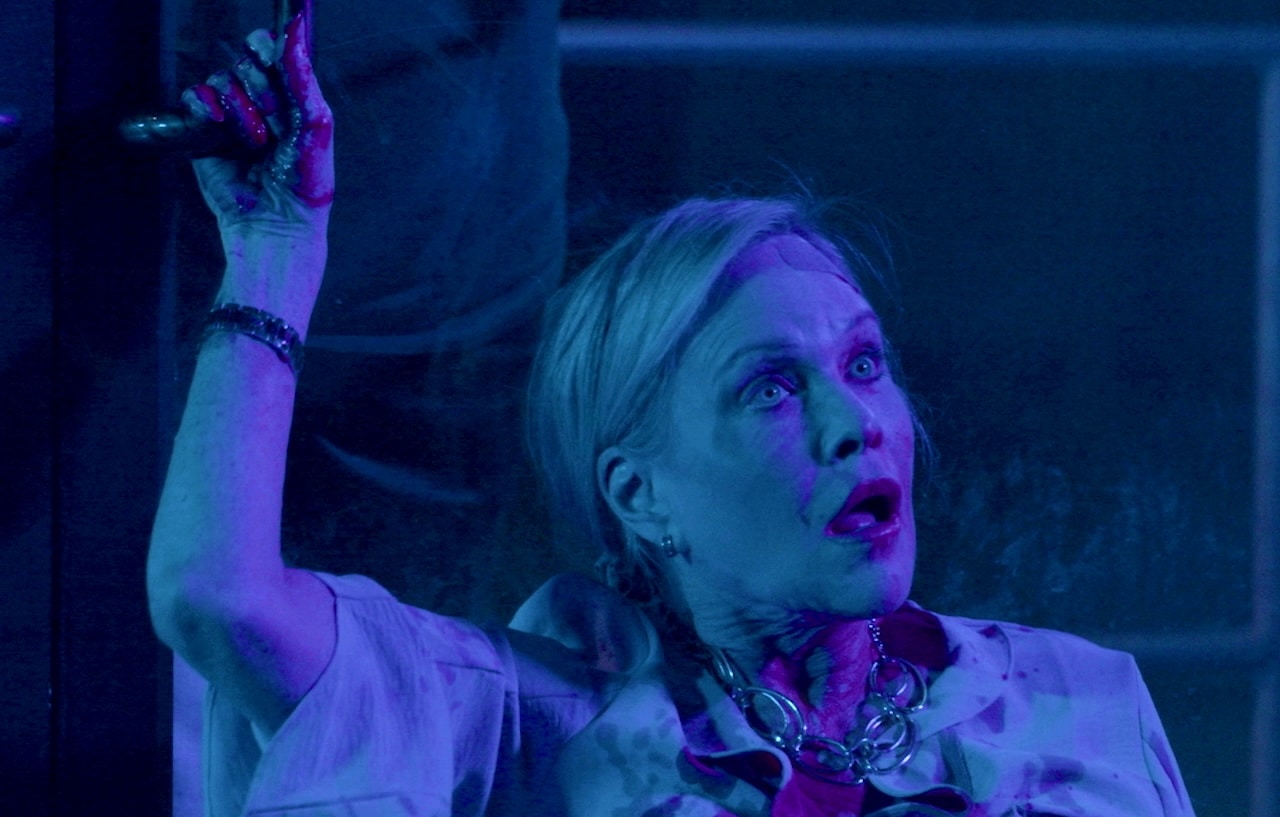
The people in the world are also given their moments you have Keni Bounds as Detective Hicks who has some food issues and some good lines. Jo-Ann Robinson as Mona and her husband property developer Greg played Jeff Buchwald have some happy religiously vapid moments disguised as helping others while concealing their own troubles. Screen veteran Lynn Lowry delivers a hugely poignant study of grief and conviction regarding identity in a video that is part of the investigation
Not everything works. The middle section occasionally stops the thriller dead to concentrate on Drew and Connor’s odd-couple relationship, and the film could probably lose some running time without sacrificing character development. There is also a dance sequence between Conner and Drew that perhaps is homage to some of the same shown in Dario Argento’s Suspira or Opera. Owen becomes his own tragic figure in the film ands it’s refreshing to see the effect this has on Drew. In an perhaps an American moment actor Will Lovern mispronounces the grape style Pinot Noir which is to be spoken like Noir is Film Noir. Interestingly that does work as it does show many don’t quite get the European way, so they change it to fit.
Until You’re Alone may wear like the rain coat yet it shows underneath is its own film with something to say about inclusion, belonging and relationships for all without being preachy. It’s bloody, funny, sexually frank and occasionally excessive qualities that make it feel very much at home in the wonderfully disreputable tradition it is celebrating.

