
By Terry Sherwood
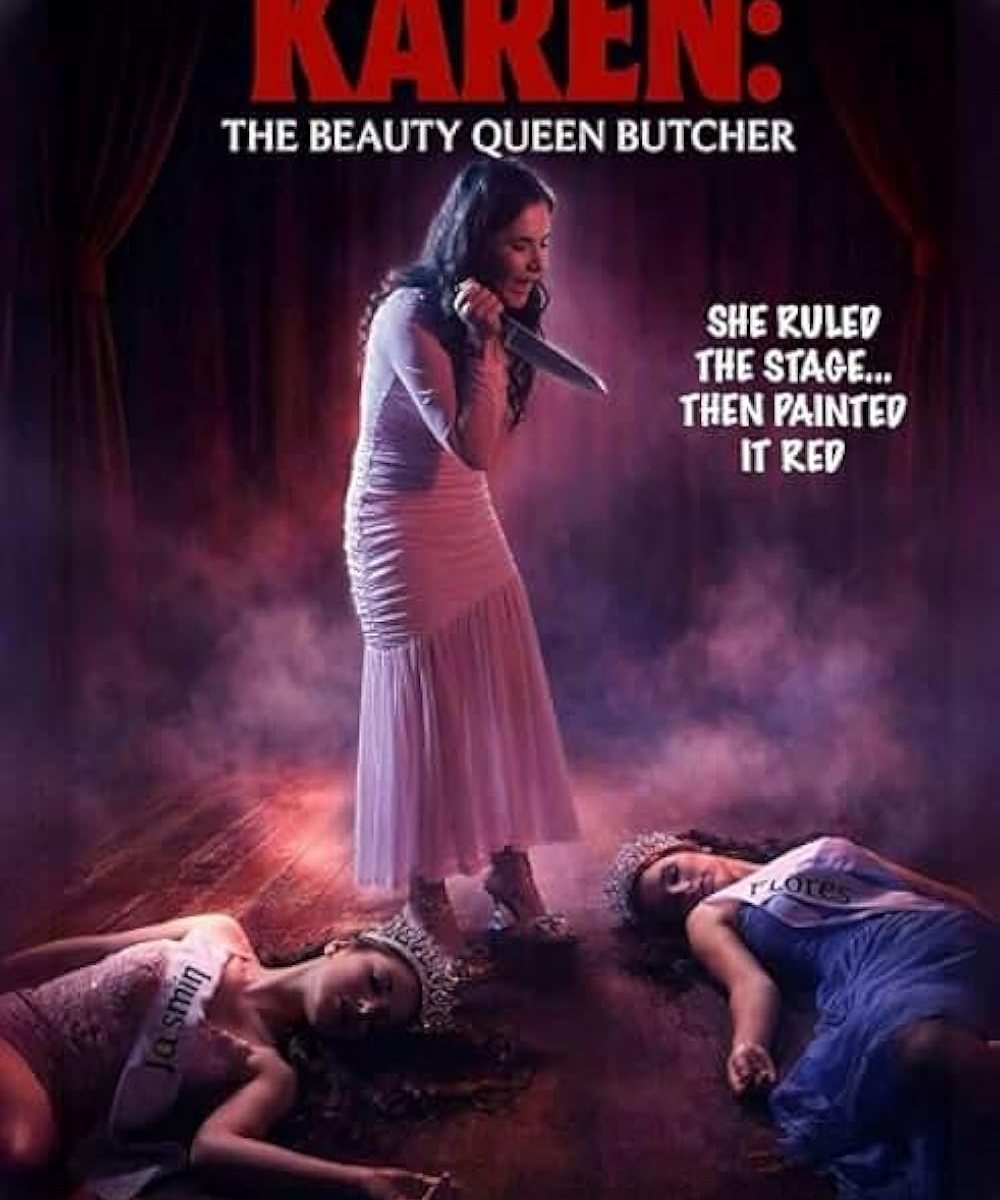
This is a bit of a difficult piece to write, as it is something that I would find. I think the same with the audience as the film I viewed, Karen the Beauty Queen Butcher, was an AI-generated movie, not necessarily created entirely by artificial intelligence but perhaps assembled with AI-written dialogue. AI-assisted storytelling, or heavily AI-generated visuals. That is something the audience will decide.
Watching the finished film, I was struck by the ridiculous dialogue, and the meandering plot was even by B-movie standards. The effects on the first kill also struck me as odd; when the second happened, I was puzzled how that look was achieved. Then it connected, and you can see the inhumanity in backgrounds and people doing the same action, much like a crowd in a sports pc or PlayStation game. The movie frequently resembles what has become known online as “AI slop” that deprives people of work content that imitates the look of a real production while lacking the human touch that gives films personality, rhythm and emotional credibility.
. Karen: The Beauty Queen Butcher (2026) is an independent B-movie slasher that features real live-action actors (Jasmin Flores as Karen) but heavily utilises AI-generated visual effects and backgrounds. The movie’s unique, AI-manipulated look is actually one of its defining traits. Instead of hiding the digital manipulation, the director leaves it front and centre to give the film a surreal, dreamlike (and sometimes unsettling) aesthetic. For a look at the wild, campy, and heavily digitally altered visual style of this indie slasher:
Directed by Zachary Snygg, Karen the Beauty Queen Butcher begins with an intriguing premise. Karen (Jasmin Flores) is obsessed with winning beauty pageants despite already being married to the endlessly patient Ted (Scott Bolger). As pageant contestants begin turning up brutally murdered, Karen’s ambitions grow even stronger, eventually placing her at the centre of the investigation. It’s a concept that could have become a biting satire of vanity, celebrity culture and obsessive ambition. Instead, it gradually collapses beneath the weight of its own gimmicks.
The opening is energetic enough. A woman carries a beauty pageant crown through the streets before the first gruesome murder arrives only minutes later. Blood flies, knives seemingly melt into flesh, continuity slips appear almost immediately, and the visual effects have an odd dreamlike quality. At first this almost feels intentional, as though the film is aiming for an exaggerated comic-book style.
Background crowds appear to be digitally generated throughout much of the running time. People repeat identical movements in loops, police officers sway in synchronised patterns during meetings, gym patrons exercise on treadmills that seem to disappear into walls, and city scenes possess an oddly lifeless quality. Rather than creating a believable world, these artificial backgrounds constantly draw attention to themselves.
One can say this was inevitable or the same as having people stand in front of a green screen or, in days past, a matte painting or rear projection. The main difference is that these still employed departments of painters, technicians, footage gatherers and stop motion animators like Ray Harryhausen and Willis Obrien. I question the commitment to the art of filmmaking in the makers of this, from the top down. More than the understanding of the process and actually doing the work.
Ironically, there are moments showing genuine filmmaking talent. Several sequences are attractively lit and competently photographed. Some compositions reveal an understanding of visual storytelling. These moments make the digital environments even more frustrating because they suggest a better film buried beneath the artificial gloss.
The screenplay struggles just as much as the visuals. The mystery surrounding the serial killer never develops genuine suspense because the likely culprit is telegraphed almost from the beginning. There are few surprises, and the investigation proceeds more through routine than genuine intrigue.
Karen herself is also difficult to engage with. Rather than becoming an entertainingly outrageous anti-heroine, she’s simply unpleasant for much of the film. She criticises Ted over insignificant things, constantly moves the goalposts in their relationship, obsesses over dieting and pageants, and generally treats everyone around her with contempt. Dark comedies can succeed with unlikeable protagonists, but they still require some depth or charisma. Karen rarely displays either.
The murders embrace outrageous B-movie excess. Victims are dispatched with absurd creativity: one is stabbed through a breast implant, another ends up with a flute protruding from her body, while another suffers such an exaggerated hammer attack that her hair separates from her head before the body hits the floor. These sequences aim for over-the-top comedy rather than realism, but they rarely achieve the “so bad it’s good” charm the filmmakers seem to be chasing. More often, they simply feel awkward.
The climax only amplifies the absurdity. Karen crowns herself with a severed hand while flashbacks replay previous murders in an attempt to provide thematic weight. Instead of delivering a satirical statement about beauty culture or obsession, the ending simply throws increasingly bizarre images at the audience without earning them emotionally or dramatically.
Independent horror has always succeeded by proving that imagination matters more than money. Karen the Beauty Queen Butcher instead demonstrates that no amount of technology can substitute for thoughtful storytelling and authentic filmmaking. AI slop, it remains. For shame.

