
Amicus Productions is back with a brand new horror anthology In The Grip of Terror, from writer/director Lawrie Brewster.
Brewster is joined on co-directing and acting duties by Megan Tremethick, for segment A Diagnosis of Death. Megan also stars in another segment, The One Way Ward.
We caught up with Megan to talk all things, horror, Amicus and directing plus so much more.
You are pulling double duty on In The Grip of Terror, how did it feel to direct but also star in one of the segments?
It felt like a huge honour to not only play a role in the first new Amicus horror film in years, but also to co-direct a segment alongside the wonderful Lawrie Brewster and the brilliant Caz Paul. Of course, it was also incredibly daunting. I would be a fool not to be daunted by the responsibility that comes with the legacy of Amicus Productions.
At the time we shot the segment, A Diagnosis of Death, we were also filming my feature directorial debut, my ASMR horror film Spoiling You. Filming for both projects was incredibly close together, and some scenes even overlapped. However, I had my wonderful co-directors to share the load with, and both films are tonally very different, which helped a great deal.
I truly adored the filming days for both projects and made sure to stay laser-focused while also enjoying the experience as much as possible.
You’ve worked in the British genre space for a while now, how was your experience working on this compared to other projects?
In The Grip of Terror definitely allowed for more preparation time than some past projects I’ve worked on. On certain films, we’ve shot the entire project in seven days or less, often with only a few weeks of prep beforehand.
With In The Grip of Terror, there were months of planning, and as it was an anthology, it made sense to shoot in smaller blocks with preparation time in between. That approach meant each segment, as well as the wraparound, could be given the time and attention it deserved.
We were shooting other projects at the same time, which meant a high level of focus was needed for each filming block. Personally, I really enjoy working that way, and I felt very in tune with everyone on set. There was a shared desire to get it right, and that atmosphere was very present throughout the shoot.
I also really valued the extra time for character preparation. I like to put the work in beforehand, as it allows me to feel more relaxed on set and gives me greater confidence in my performance.
It feels quite unique what is being crafted at Hex with delving into retro horror and fantasy stories, was this part of the appeal of working with the studio?
Yes, absolutely. British Horror Studio, formerly Hex Studios, is a real joy to work with because every film feels genuinely different. They are often wildly distinct from one another, which keeps things creatively exciting.
I also feel very lucky to be trusted with as much creative input as I am. Being part of the core team allows me to help design costumes and make-up, and to contribute behind the scenes wherever I can. I have become so used to that level of involvement that I think I would initially struggle on a project where I simply turned up, acted, and then left again.
I have always loved vintage films and fashion, so the studio’s strong leaning into those influences really excites me. At the same time, I want to remain a creative chameleon. I would hate to be pigeonholed into one thing.
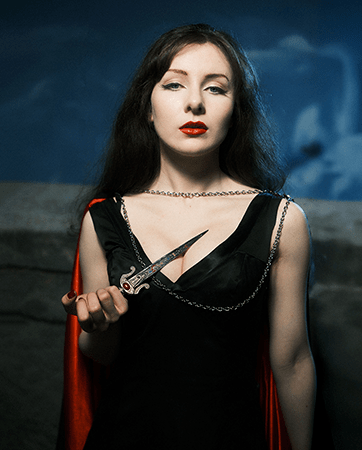
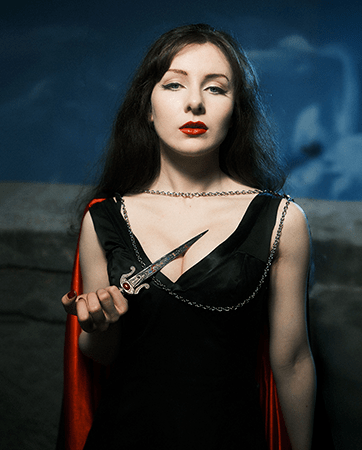
Working with the studio allows me to play a gutsy 1990s goth documentary filmmaker in one film, then a seductive 1980s sword and sorcery-style sorceress in the next, or even the character in my own film Spoiling You, a bubbly and soothing on the surface, yet sadistic ASMR hostess dressed in a French maid costume with pink hair and cat ears. I love that at British Horror Studio, we reject the mundane.
Now that you’ve directed a segment within a feature, can you tell us more about Spoiling You, the full-length feature you directed around the same time, and what audiences can expect from it?
Spoiling You stars Stephen Kerr as Drew, a lonely and isolated man who relies on ASMR videos to feel a sense of human connection. Miss Mutter, an ASMRtist played by me, whom he devotedly watches, announces an in-person ASMR session for her number one fan. Drew finds himself the lucky winner… or perhaps not so lucky?
I love 1990s and early 2000s J-horror and extreme Asian cinema, particularly the work of Takashi Miike. When I first watched Audition, I felt completely mesmerised by its surreal visuals and dream-like narrative. Elements of J-horror’s aesthetic and metaphoric narrative structure certainly influenced Spoiling You, but I also didn’t just want to create a pastiche. I wanted to take those influences and put my own twist on them.
I have also watched ASMR videos for nearly ten years. They help me relax, and they inspired me to create a character and story that explore themes which are deeply personal to me.
I am also completely honoured that Laurence R. Harvey stars in a very special and memorable role connected to Miss Mutter and the world of Spoiling You. His performance is fantastic, and I cannot wait for audiences to experience this character. The film is set to have its world premiere this year, and I am very excited to finally share it with audiences.
Do you think it helps being an actor before getting behind the camera?
I certainly don’t think it hurts, especially when it comes to directing. As a director, I always try to be mindful of each actor’s process so that I can help them give their best performance.
Lawrie Brewster also trained in acting and regularly performs. He appears in In The Grip of Terror as well as serving as the main director, and I imagine he would say that his acting background has helped him enormously. He is very much an actor’s director and has a real ability to draw out unique, interesting, and powerful performances. His approach has definitely inspired me as a director.
I would also say the reverse is true. It can be hugely beneficial for an actor to work as part of the crew, even if only once. You gain a much deeper understanding of how a set functions, which I found grounding. It made me more considerate of the crew and helped me find ways to make their working days a little easier wherever possible.
What was the most fun about filming the segments The One Way Ward and A Diagnosis of Death?
The most fun part of filming The One Way Ward was working with Jane Merrow, Jonathan Hansler, and Chris Capaldi. They are all incredibly talented and lovely people, and the chemistry between the characters felt very natural and effortless.
For A Diagnosis of Death, the highlight was definitely filming the dance sequence near the end. Caz and I worked closely on the scene with cinematographer Michael Brewster, and it was an absolute joy. I choreographed a piece inspired by 1960s dance styles for the patients, which I later taught them, as well as a separate routine for the nurses, which I also got to perform myself.
Given time constraints, all of the choreography was learned on the day, but everyone picked it up so quickly and threw themselves into it wholeheartedly. It was a joyful experience!
Tell us about your character, Nurse Charlotte Gibbon, and did you use any real-life or movie nurses as inspirations for parts of the character?
Nurse Charlotte Gibbon is a character with many opposing facets. At the beginning, the version of her suffering from supposed amnesia is cold, clipped, and distant, almost otherworldly, and somehow threatening. We then see her on her first day at the hospital, where she appears almost painfully young and naive, trying not to blush at the dashing Dr Maitland, played by Chris Capaldi. As the story unfolds, it becomes clear that she may not be as naive as she first appeared, leading to a complete transformation.
She is constantly evolving throughout the film, and that was incredibly satisfying to embody as an actor. It’s what you hope for in a role.
My starting point was rewatching the classic Amicus films. Although our film is set anachronistically, it’s very reminiscent of classic Amicus, and Lawrie Brewster encouraged all of the actors to study both the films and the performers who starred in them. I was more than happy to do that. I love the performance styles and dialects of British actors from the 1960s and 1970s, and I enjoy playing transformative roles that require studying and analysing the past.
Although I have an embarrassingly bad memory, I do find history fascinating and want to keep learning more about it, hopefully retaining what I learn! I have found that playing characters that require research into different eras is a great way for me to learn more at the same time.
While I didn’t draw inspiration from any real-life nurses per se, I researched the profession and how nurses in the 1960s and 1970s approached their working days. In terms of inspiring screen performances, one that immediately comes to mind is Jenny Agutter as Nurse Alex Price in An American Werewolf in London. I loved how grounded she felt, yet effortlessly charismatic.
Other performances that informed my approach were Charlotte Rampling’s Barbara in Asylum, as well as elements of Britt Ekland’s dreamlike portrayal of Lucy in the same segment (Lucy Comes To Stay). Nurse Charlotte has several very different sides to her personality, all of which are revealed over the course of the film, and these inspirations were useful touchstones whenever I needed them.
I also really enjoyed learning a hybrid, heightened form of received pronunciation that many British actresses used in the 1960s and 1970s. I had fun emphasising the accent or dialling it back slightly, depending on whether Nurse Charlotte was being vulnerable or leaning more into her femme fatale side. Learning the accent was definitely a highlight of my character preparation.
Do you have any special affinity for the ‘classic’ British horror from studios like Amicus or Hammer?
I absolutely do. When I was around ten years old, my dad introduced me to films from both Amicus and Hammer. He loves classic British horror and science fiction, so I suspect that is where my affection for the genre began.
I grew up watching, and still revisit, films such as The Gorgon, the Christopher Lee Dracula Hammer classics, The Vault of Horror, Dr Terror’s House of Horrors, and Tales from the Crypt. Those films have stayed with me and continue to influence my taste and creative interests.
Tell us about working with Lawrie Brewster and Sarah Daly?
They are both incredibly inspiring people to work with. Not only are they creatively gifted, but they are also kind, generous, and immensely hardworking. Sarah is not only a stunningly talented screenwriter, but also a prolific musician, poet, and artist more broadly. Lawrie is an exceptionally skilled director, writer, editor, sound designer, and creative, with a real understanding of every aspect of the filmmaking process.
Their work ethic is genuinely admirable, and they both deserve far more credit for how tirelessly they work to keep British Horror Studio moving forward.
The wider team is just as hardworking, including Tom Staunton, Michael Brewster, Paul William Kelley, Neil Cooper, and many others. Everyone wears multiple hats at the studio, and there is a strong collective mentality that I find very inspiring.
With several British horror studio productions set to premiere at film festivals this year, do you enjoy the festival experience as a creative, or do you find it a bit stressful?
I personally love attending festivals. I have not been to a huge number, but I always look forward to the Romford Horror Film Festival and the Romford Film Festival in Essex, London.
The people behind the festival, including Spencer Hawken, Natalie Bays, Peter Blunden, Daniel Smales, who also runs the wonderful Glowflare Horror Film Festival in Beverley, Kevin Haldon, Carrie Kendall, Hannah Davis, and their team, are all so welcoming and passionate. It is their hard work, dedication and friendship that make the festivals such a positive experience, and why I look forward to returning each year.
It’s such an honour to see your creative work on the big screen, and I think it’s important, and motivating, to celebrate those moments whenever possible.
What is the plan in terms of a wider release?
In The Grip of Terror is currently available to purchase through British Horror Studio’s Patreon store, with Blu-ray editions also available. The British Horror Studio Patreon itself is free to join, and any financial contribution is entirely optional. It is simply there for anyone who enjoys our films and would like to support the artists and our ongoing creative projects further.
Find out more about In The Grip of Terror on Patreon.
 Bloody Flicks