

By Mark Hockley
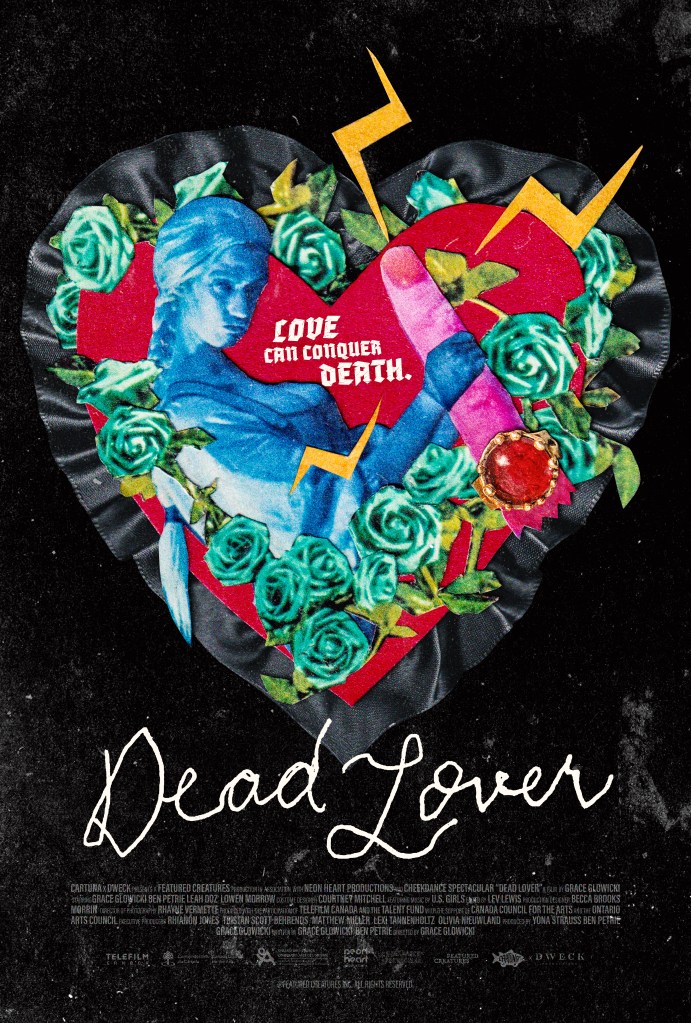
Dead Lover unfolds in a world that sits somewhere between theatre and cinema, and it makes no attempt to hide that fact. Rather than aiming for realism, the film embraces artifice, building a carefully controlled space where performance, design, and mood take priority over naturalism.
At its centre is a solitary gravedigger, whose quiet, repetitive existence is briefly interrupted by a moment of human connection. When that connection is lost, the story turns toward obsession, as grief gives way to an attempt to reverse death itself. It’s a familiar narrative in outline, but here it’s presented less as a continuous story and more as a series of heightened, self-contained scenes—closer to staged tableaux than conventional drama.
The visual approach reinforces this. Sets feel deliberately constructed rather than lived-in, with lighting and colour used expressively rather than realistically. Every frame is composed with precision, and characters often move with a sense of choreography, as if guided by an unseen rhythm. The film is constantly aware of itself as a creation, inviting the viewer to engage with its form as much as its content.
Performances follow the same logic. Emotions are externalised through exaggerated gesture, vocal delivery, and facial expression, pushing the characters into a distinctly theatrical register. Yet within this heightened style, the film occasionally allows moments of genuine emotional clarity to surface. These quieter beats don’t undermine the artifice—they give it weight, creating a tension between performance and sincerity that runs throughout.
Narratively, the film moves in a clear arc—from isolation, to connection, to loss, and finally to reconstruction—but it resists straightforward storytelling. Scenes often function as variations on a theme, building meaning through repetition and accumulation rather than direct exposition.
A recurring focus on the physical body—its decay, its reconstruction, its presence—grounds the film’s more abstract tendencies. These tactile details prevent the stylisation from drifting too far from something recognisable, anchoring the film in a visceral, often unsettling reality.
Ultimately, Dead Lover is a film of deliberate excess, but one that operates within strict formal control. Its stylisation is not incidental; it’s the organising principle. By holding artifice and emotion in balance without resolving the tension between them, the film creates an experience that is at once distancing and affecting—unusual, precise, and quietly compelling.
Dead Lover is available now on streaming platforms.
 Bloody Flicks