

By Terry Sherwood
The “one-shot” film similar to Sam Mendes war film 1917 has moved from a subgenre of horror that rings of a “discovery’ for some. Refined from the days of Halloween, Friday the 13th franchises plus many Giallo examples you have Adam O’Brien’s Bury the Devil enters the fray with a high-wire act that manages to feel grounded. It is a film that positions itself at the “demented intersection of Evil Dead and Mother!” blurring the lines between a thriller and a supernatural descent into madness.
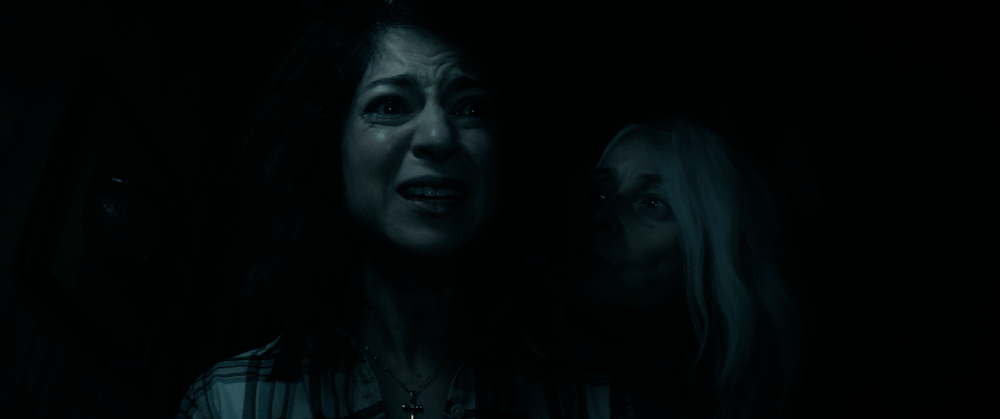
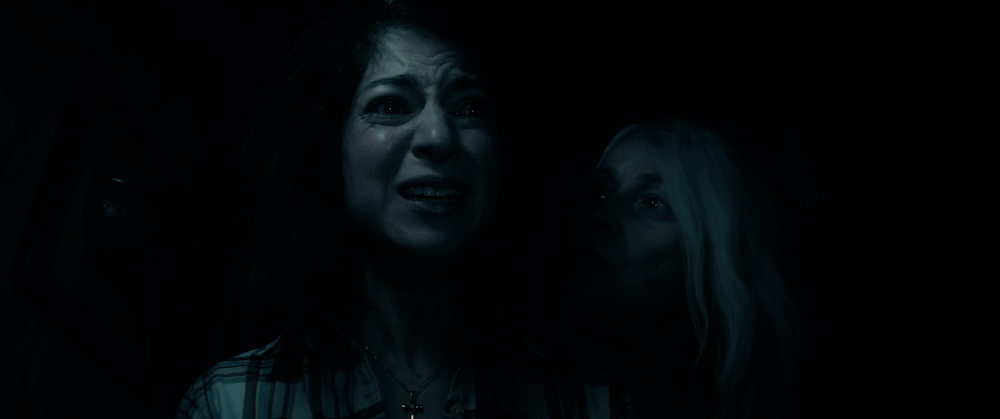
The work opens with a nocturnal shot of an old lakefront house engulfed in CGI flames, punctuated by a “75 minutes earlier” on screen title. Segue to Julia (Emmanuelle Lussier Martinez), a live in nurse seeking a fresh start that one learns later after the death of her mother and a demanding father. Her new placement is Evelyn (Dawn Ford), a woman suffering from advanced dementia whose mental state is a shifting tectonic plate of vulnerability, nostalgic sweetness, and sudden, “sly malice.”
The house is a sprawling, multi-level wood paneled labyrinth that cinematographer Benoit Bealieu navigates the story. Unlike some single take, Bury the Devil feels remarkably smooth. The camera floats through wood-hallways and down creaking staircases like a spirit or a third person running around ‘filming:” and event on a phone. Evelyn’s estranged husband Randall (Bill Rowat) arrives to rant about incantations in the middle of the night only to return with a gang of middle-aged vigilantes and a priest.
Bury the Devil links demonic possession with the symptoms of dementia similar to The Taking of Deborah Logan explored this earlier. Dawn Ford delivers a strong, vulnerable performance, transitioning from a confused soft spoken elderly woman to a entity without the aid CGI chiefly on facial and voice inflections. It is a metaphor for the loss of self that age and diseases can do to one person. Playing against this in what is essentially a “two hander’ Emmanuelle Lussier Martinez as Julia provides the compassion, sympathy with the right amount of ‘ordinary person caught in extraordinary circumstances resolution
As the film progresses into a full-scale ritualistic standoff. O’Brien utilizes “spinning camera” sequences during the height of the possession, While the film occasionally relies on tropes of a creepy cassette player, an ivory statue, and the basement of revelation as opposed to an Attic. These plus the fluid camera make it look like a videogame that seems to be influencing how filmmakers package stories like this for their audience.
The script, co-written by Brad Hodson and Philip Kalin-Hajdu, is it strength its pacing of a mere 86 minutes again drawing one to compare this to the video game audience. Bury the Devil does not fall like many of these “space or sound only thrillers like the unbelievable tripe of Skinamarink and undoubtable others to follow the mistake stillness for plot when all it shows absence of ideas. Again, not jump scares all the time which is what many are conditioned to but this constant stillness with some odd sound is easier to do with no budget which is simply lazy as it gives it to the audience to figure out. Two punk slogans comes to mind ‘People will find art in anything or ‘You will pay a lot for what you already know”.
Bury the Devil can’t help but look like a combination of found footage with game movement. It repackages a story with some compelling character work and ensemble cast in a new way with some technical moments and some genuine scares like a sequence with Evelyn in silhouette down a hall saying lines a meek voice .It serves as evolution of O’Brien’s previous work, Mom, with the groundwork for a trilogy just like your next version of Resident Evil.
 Bloody Flicks