

By Terry Sherwood
Missing Child Videotape slides a cold hand into yours, during the film this actually happens and refuses to let go. Director Kondo Ryota expands his short film into a feature that isn’t about jump scares or orchestral shocks. It’s about silence, memory, and the feeling that something is standing just behind you.
Keita Kodama (Sugita Rairu) lives a small, quiet life. He works at a grocery store, shares a cramped apartment with his roommate Tsukasa Amano (Hirai Amon), a teacher who happens to be psychically sensitive, and spends his spare time helping track down missing persons. When we first meet him, he’s just found a young boy long thought gone for good. The child in question clings to him and whispers, “Big brother.” It’s tender. It’s eerie.
Thirteen years earlier, Keita’s little brother Hinata vanished while the two were hiking and exploring local Mt. Mashiro. The guilt never left him. It only got worse when his mother sends him a box of his late father’s belongings including an old camcorder tape Keita shot on the day of the disappearance.
On the tape is a strange building in the woods that cannot be located by authorities hunting for the missing boy. Shades of Brigadoon and more importantly the Castle in another J horror film Lake of Dracula. This place looks like an huge concrete institution with classrooms, offices and corridors. Even in the light of day, it is abandoned. It feels wrong.
Enter journalist Mikoto Kuzumi (Kokoro Morita), who is working on story who approaches Keita for what she claims will be a sympathetic feature about his search-and-rescue efforts. Naturally, she starts digging into history of Mt. Mashiro, she discovers, has a series of disappearances. People go missing there with some reappearing in an altered state.
This is familiar territory since Director Ryoto Kondo is working with Executive producer Takashi Shimizu, the mind behind Ju-On: and The Grudge. “Missing Child Videotape” isn’t just the familiar elements instead it’s the classic dread and implied fear of the Robert Wise version of The Haunting. Unlike many of the modern mimics of this style like In a Violent Nature that try to use the images and the pace with all the feel and panache of an automated social media Birthday greeting, this film succeeds stunningly in moments.
The film moves deliberately like a marching soldier towards and objective Scenes linger. Conversations trail off. Long stretches unfold in near silence. There’s barely any score. Instead, we get wind through trees, the low hum of empty rooms, the faint hiss of VHS static. The lovely use of background and foreground action giving the whole frame a look of being composited with purpose. The film clearly has no interest in cheap jolts. No cat jumps out of a cupboard. No sudden shrieks. You’re never entirely sure what you’re seeing, or whether you’re supposed to be afraid yet
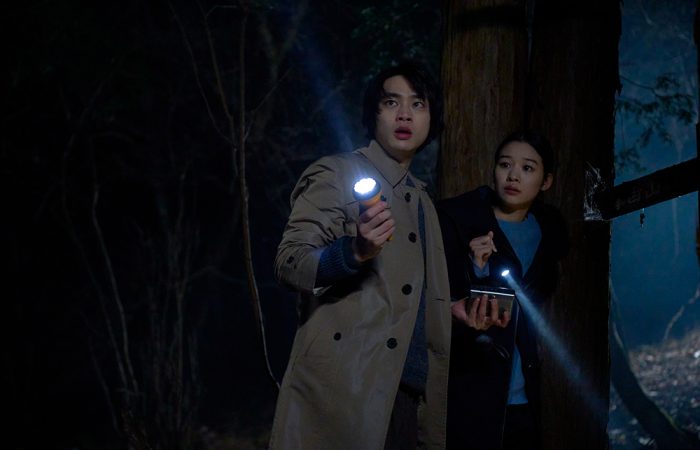
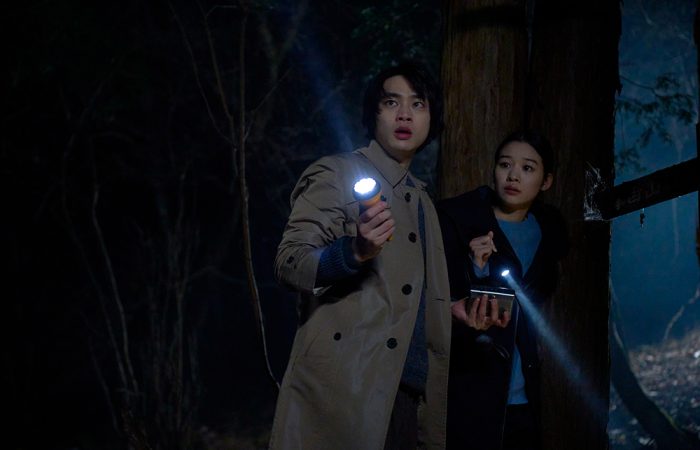
Mt. Mashiro itself is the film’s greatest creation. Even with the ‘found footage’ moments the nocturnal accent with the fog the flashlights, the silence bring out real dread. The woods are really like that at night having experienced it myself, it’s a presence. The forest feels watchful. The air seems heavy. When Keita, Tsukasa, and Kuzumi finally head back to the mountain to confront what happened, One finds its place to discard items in this case funeral urns with human ashes. Totally brilliant moment when the son of family hotel worker confesses to Keita doubts about his own origin and that of his mother due to the mountains influence on his family.
The performances maybe too restrained at times. Rairu Sugita plays Keita as a young man hollowed out by guilt, but he’s so internalized that he risks fading into the gloom. Tsukasa’s psychic sensitivity is intriguing but underexplored. The film hints at big ideas trauma, survivor’s guilt, the way grief distorts reality but never fully cracks them open. Kokoro Morita at the reporter seems to bring them both together yet her impending journey as a new reporter shows growth in the closing bits of the film.
If you need clean answers, look elsewhere. “Missing Child Videotape” closes on an unresolved note that will either frustrate you or haunt you. There’s no neat bow. No comforting explanation. Just the sense that some places and some losses don’t want to be understood. Like the quote from James Whales The Invisible Man ‘He meddled with things man was meant to leave alone’ in this case it might whisper back. Unstated brilliance.
Missing Child Videotape plays as past of the Japan Foundation Touring Film Programme 2026 takes place in cinemas around the UK from 6 February to 31 March 2026.
 Bloody Flicks