

By Terry Sherwood
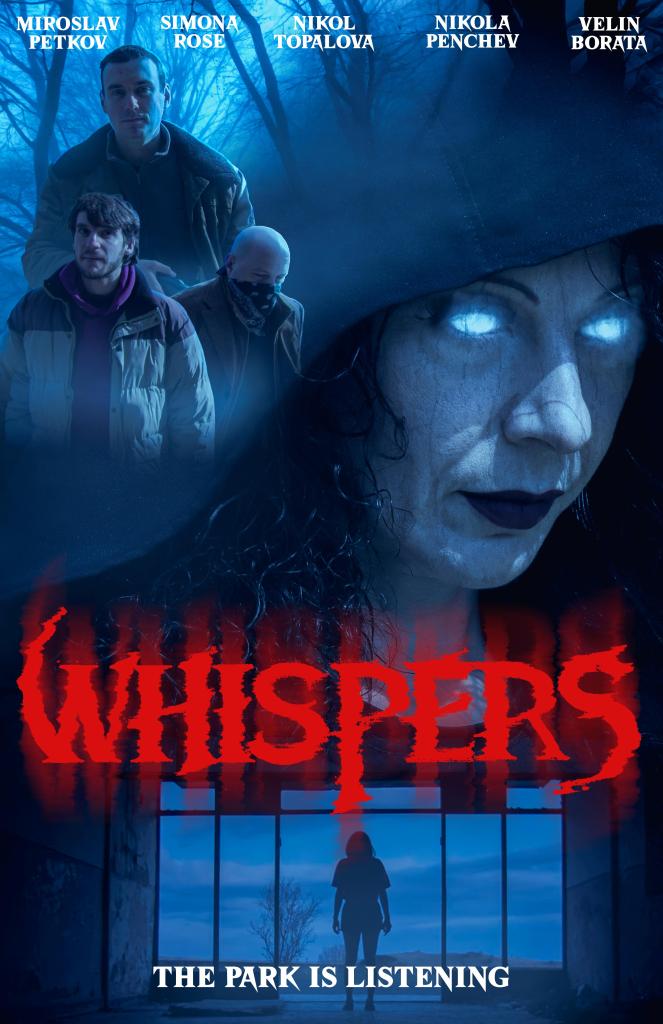
There is a particular kind of horror film that announces its limitations almost immediately such as small cast, sparse or limited locations, low effects that doesn’t hinder a story nor should it. Whispers, a Bulgarian film written and directed by Miroslav Petkov, belongs to that category: a film that understands it cannot overwhelm you visually, so it instead unsettles you and quite frankly confuses you layering on moments away from the spine of the story.
Originally conceived as the third entry in a short-film trilogy following The Whisper and The Whisper 2: Natural Connection, Whispers ultimately grew beyond the confines of a short format and emerged as a feature-length sequel which is a caveat. Does one have enough story for a feature length film should be a question? That ambiguity sometimes frustrating makes for interesting monetary viewing followed by periods of what and why did something happen because it is low key in its production
The film’s central mystery revolves around Bonnivar Park, a vast natural area on the edge of town, has become a site of unexplained disappearances. Over the years, people vanish without witnesses, bodies, or rational explanation. Locals whisper about curses and put up posters Authorities have no answers. The park simply consumes. Two young women: Sophie, who vanishes first, and Maggie, who disappears while searching for her become victims.
Alex enlists the help of Nick, Sophie’s partner, and Caine, a mute, masked man who has also lost someone to the park. Their investigation leads them to an abandoned building deep within the forest which is a place rumored to be connected to the disappearances, a structure that feels less like a physical location than a wound in the landscape.
One of the film’s most distinctive formal choices is its chapter-based structure, in which the same overall timeline is revisited from different character perspectives. Each chapter opens with a title card bearing a character’s name — Alex, Nick, Caine, Gwen making it like a book written by Philip K. Dick or J. G. Ballard in this case closer to Stanislaw Lem . Scenes overlap. Moments repeat. Actions witnessed in one chapter are reframed in another, often with additional information revealed before or after the moment we thought we understood.
A fleeting background detail becomes central. A confusing interaction suddenly gains emotional clarity. What first appeared random begins to resemble intention which is all well and good, but it fails the audience in that one feels that someone is trying to trick you. The result for me is needless layering and trying to be clever over a simple direct story. This approach evokes puzzle-box storytelling in line with Christopher Nolan’s film Following which this isn’t, nor does it try to be. Result confused voice, confused story and an attempt to be scholarly when it simple is not necessary
Character is the ley and in this case one finds Nick is defined almost entirely by loss. He is Sophie’s partner. He is grieving. He is searching. But beyond that, he remains frustratingly opaque. Unlike Alex or even Caine, Nick lacks distinctive behavioral traits, emotional contradictions, or internal conflict. He exists functionally rather than psychologically. Alex, portrayed by Petkov himself, becomes the film’s center. His chapter and his repeated presence throughout others tries to ground the film emotionally, even as the narrative drifts further from realism.
The sibling bond between Alex and Maggie is conveyed through dreamlike flashbacks that blur the boundary between memory and hallucination why is never explained Loss is not linear. It does not arrive politely in flashback form. It interrupts. It overlays reality. Whispers understands this, using disorientation not merely as a horror tactic but as an emotional language that served no purpose.
As Alex ventures deeper into the park and closer to the abandoned building, his sanity visibly erodes. He becomes obsessive, reckless, and increasingly disconnected from reality. Whether this deterioration is caused by supernatural influence, psychological collapse, or both remains deliberately unclear and that is a downfall. You cannot be odd for the sake of being odd to fit a story. Would be different its was a time anomaly or some sort of rift bridging worlds inside a house or building.
Caine is one of the film’s most visually striking figures: tall, silent, masked, physically imposing. He feels mythic even before the supernatural elements fully emerge. His muteness and minimal gestures invite projection, and his grief seems heavier precisely because it is not verbalized once again never alluded to or shown who he is.
This approach works best when the film leans into abstraction. It falters slightly when narrative demands clarity that the film cannot visually provide which is its downfall. Ambitious yes good try yes but triumph of concept over execution dealing with complex themes and overlapping worlds Budget constraints limit what can be shown inside the building, and some climactic moments lack the visual density needed to fully land their horror which should not matter .
 Bloody Flicks