


By Terry Sherwood
Self-Help is the latest and perhaps most accomplished outing from director Erik Bloomquist and his brother Carson Bloomquist, in this case events that are desperate and disorienting at a wellness retreat that ends in a flurry of manipulation, guilt, and blood that is ultimately one wonders why is this happening cinematically.
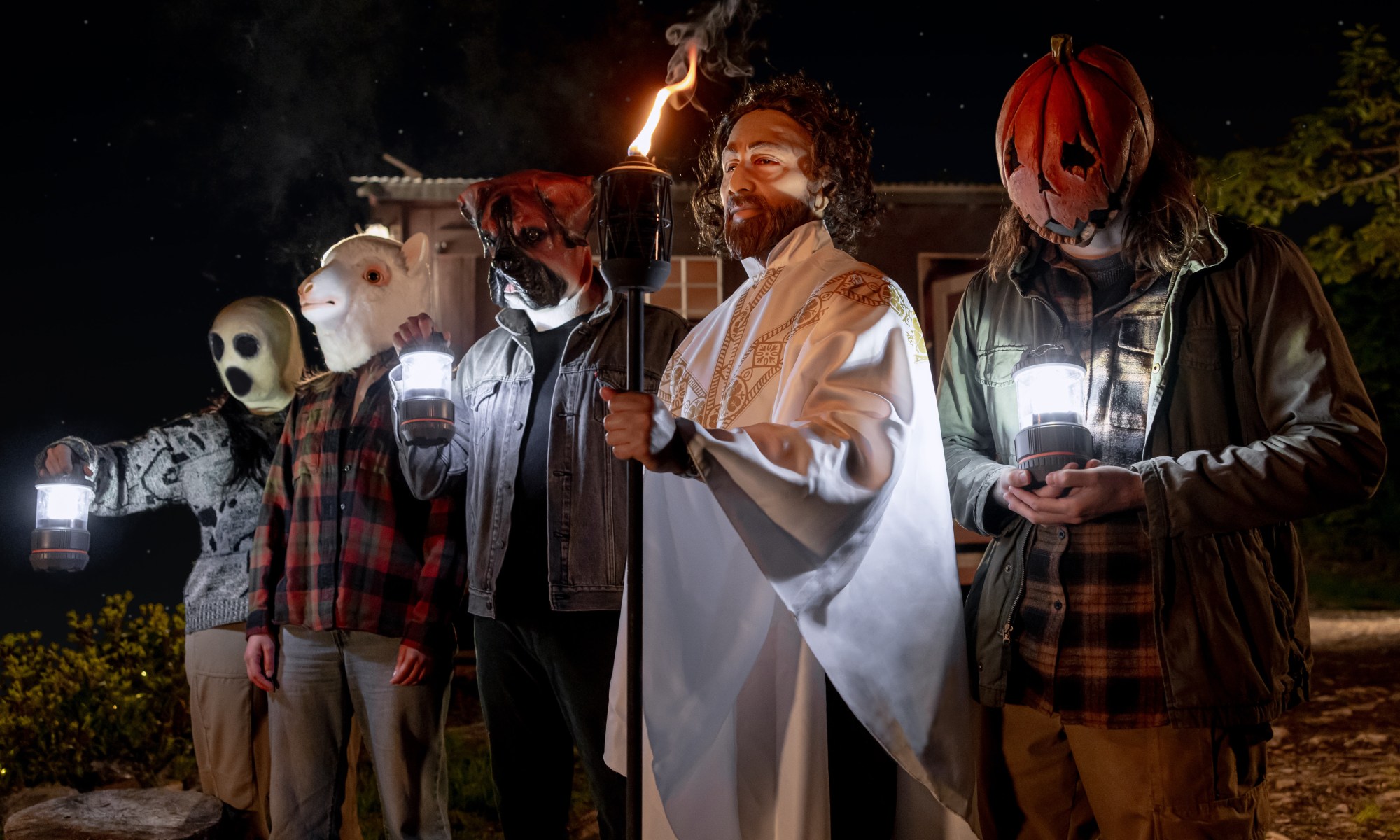
The story follows Olivia (Landry Bender), a college student nursing a strained relationship with her mother Rebecca (Amy Hargreaves). Hoping to mend their bond, Rebecca persuades Olivia to attend a self-help retreat run by her new husband, Curtis (Jake Weber), a gravel voiced guru who promises to help participants “become who they were always meant to be.” Olivia’s best friend Sophie (Madison Lintz) tags along, and together they enter a world of smiling affirmation, people in masks and chants of empowerment. From the start, Olivia’s skepticism about Curtis’s methods and perhaps his motive sets the tone for a film where nothing feels quite safe or genuine.
Is this an actual self-help retreat, or are Olivia’s suspicions correct, and something sinister is afoot?” The film delights in keeping that question unresolved for as long as possible. Curtis’s insistence that he is not “a” or “the” messiah gives the community a veneer of legitimacy, even as subtle cracks begin to show. When harm inevitably befalls some of the faithful, the retreat’s polished façade crumbles, and the danger becomes real.
If the script occasionally veers toward convolution, it’s a forgivable sin given how tautly the film sustains its confused tension. It moves around tries to cram events in from different people. Unlike many of the playing the silence genre of genre films like the horridly over rated In a Violent Nature and Skinamarink. this film stays away from long shots with zero in them.
The performances are uniformly superb, grounding the madness in emotional truth. Landry Bender delivers a good turn as Olivia, capturing every shade of confidence, outrage, and vulnerability. She anchors the story with a realism that cuts through the film’s abstract menace. Her chemistry with Amy Hargreaves is remarkable; the mother-daughter dynamic pulses with resentment, love, and unspoken grief. Hargreaves, in turn, offers a haunting portrayal of a woman who wants so badly to believe that she blinds herself to danger. She’s raw and vulnerable yet always withholding just enough to keep the audience guessing. Madison Lintz shines as Sophie, the best friend who slowly succumbs to Curtis’s charm, embodying the tragic ease with which people surrender to belief. And Jake Weber, a veteran of both art-house and genre cinema, gives Curtis a magnetic calm that makes his control over others entirely plausible. You understand why people would follow him.
Visually, Self-Help is as polished as its fictional retreat. The cinematography drenches ordinary spaces in bright, antiseptic light that becomes oppressive over time. The production design mirrors the false serenity of Curtis’s philosophy—minimalist, symmetrical, suffocating. Beneath that gloss lies a pulse of unease, amplified by a couple of practical effects sequences
At its heart, though, Self-Help is not just about cults or killings; it’s about the impossibility of escaping one’s own damage. Each character tries to “start fresh,” but their wounds always find them again. In that sense, the title becomes darkly ironic: there is no self-help, only self-reckoning. The film is just sort of there after it finished nothing else rather hollow.
 Bloody Flicks