

By Terry Sherwood
Andrew de Burgh’s The Demoness is the sort of low-budget horror that revels in its eccentricities. At once playful and sinister, satirical yet bloody in a CGI and practical way, it refuses to conform to the patterns of conventional possession or demon-lore cinema. Instead, it gives us a character study of a succubus. The beastie is called Charlotte, played by Sydney Culbertson—that plays out as half supernatural slasher, half sardonic workplace comedy, with a dash of demon confession. Satan himself makes and appearance in the role of red faced exasperated boss.
More than a series of incidents with the first moment immediately setting the film world in motion. Jack (Xander Bailey) and Sarah (Bella Glanville), a couple on the brink of collapse, are stalked in their home by an entity that slips between shadows. The demonic form resembles something unearthed from silent-era nightmares: sharp silhouettes, distorted movement, the looming menace of shadows from Murnau’s Nosferatu. The grotesque facial features carry more than a trace of Rod Serling’s Eye of the Beholder episode from The Twilight Zone with the “pig-snouted” revelation of the “monster” made human. The blend of old-school German expressionism and mid-century American television is strange, but it carves out a mood that isn’t easy to shake.
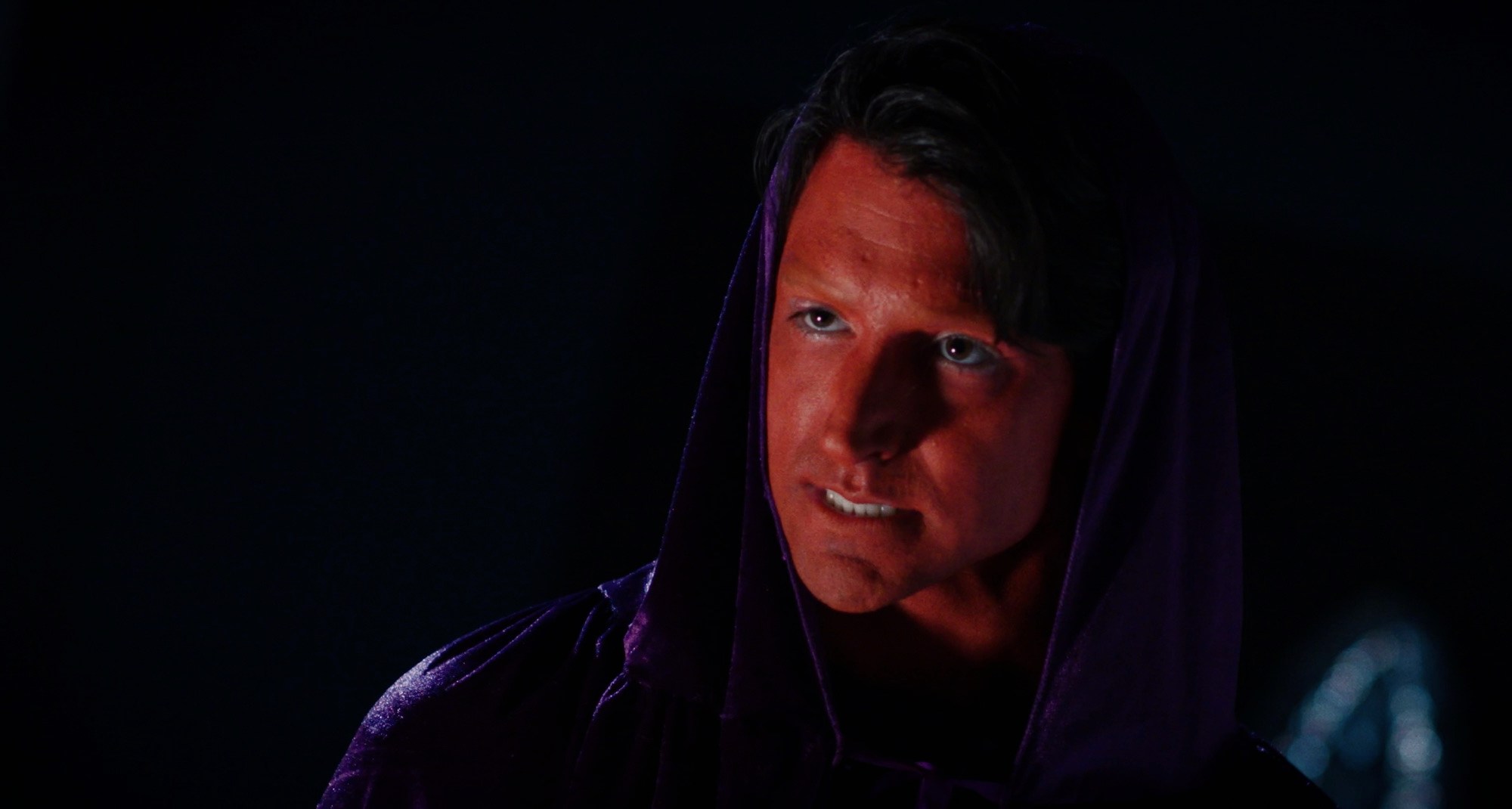
From there, the succubus seduces Jack in a dreamlike sequence, places Sarah in a trance, and disrupts their already fragile marriage by having an off-screen encounter. What makes The Demoness unusual is that Charlotte doesn’t really “arrive” until Sarah’s death and transformation. Through a pact with Lucifer (Mark Pontarelli), she gains a human form and a new name. It’s only then that the film pivots into a different mode: less about haunting couples, more about watching a demon try on personalities, flirt with humanity, and inflict death with a smirk.
Sydney Culbertson carries the film. Attractive, sly, and humorous, she sells the conceit that men might follow her home despite the unsettling aura. Her performance is halfway between seductress and stand-up comic, with exaggerated body language, knowing glances, and line deliveries that sometimes play like punchlines. It’s camp, but intentional camp, and it makes She isn’t just a demon she’s an employee fed up with her boss, trying to negotiate a better gig in Hell’s hierarchy. That workplace-satire framing is one of the film’s smartest touches.
The social commentary here is blunt, sometimes too blunt. Jack’s toxic masculinity, Sarah’s economic struggles, and the nightclub encounters with shallow womanizers all make their point but risk belaboring it. Some of these sequences drag, slowing the pace in ways that undercut the film’s momentum. Charlotte punishes men for their arrogance, corrupt detectives for their sleaze, even seemingly perfect neighbors for their hidden sins. She becomes judge, jury, and executioner always out of self-interest.
Thematically, the film toys with ambition, dissatisfaction, misogyny, self-worth, and power. Its sly joke is that a demoness’s frustration with her “job description” mirrors human discontent with careers, relationships, and life trajectories.
Cinematography works for the budget, with nightclub scenes in a obvious studio with a cyclorama behind the dancer lit in saturated color and domestic interiors cloaked in shadows. The creature design for the demoness—especially in her primal, non-human form—is memorable: rubbery, grotesque, and tactile enough to recall the practical monster’s of 1980s horror or early Dr Who. Kill effects are gory, and while some bits of CGI. The sound design adds texture, with distorted voices for the demon form and a score that oscillates between brooding ambience and ironic cues that underline the film’s camp sensibility.
Alongside Culbertson, the cast supports the film’s tonal shifts. Glanville and Bailey set the stage well almost like “two handers’ in theatre as the opener or curtain raiser embodies the tone and marital despair. Nottingham and Clifford provide energy as nightclub prey. Kitamura and Gotham, as seemingly pleasant neighbors, give their roles just enough ambiguity to keep viewers guessing. Toss in Pontarelli’s Lucifer played is a smug, sardonic, parent weary of his minion’s ambitions.
The Demoness is not a polished mainstream horror film—and it isn’t trying to be. It’s quirky, uneven, sometimes heavy-handed, with “Harold Pinter’ pauses similar to theatrical scenes with actors waiting for an audience laugh. For viewers expecting a straight ‘Punish the men” this may frustrate. For those willing to embrace its odd dialogue tone and words it offers a mix of chills, chuckles, and mayhem.
 Bloody Flicks