
By Terry Sherwood
LandLord (2025) opens with the poise and conviction of a serious ’70s blaxploitation shocker—less parody, more Noir horror grit. Imagine the street-corner fatalism of Blacula fused with the independent snarl of Count Yorga, Vampire: a world of worn hallways, gun smoke, and blood debt. Writer-director Remington Smith’s debut feature breathes through the textures of its small-town America setting with faded paint, rent notices, the hum of distant sirens, domestic poverty and then punctures that realism with something feverish, nocturnal, and old as folklore. It’s a film of survivors and hunters, of hustlers over their heads, where the supernatural rises not from castles but from evictions, and where the monsters own the deeds.
A Bounty Hunter played by Adama Abramson, saves twelve-year-old Alex (Cohen Cooper) after his mother (Meredith Frankie Crutcher) is brutally attacked by the undead in their apartment. The Bounty Hunter has come to Shadowbrook Estates on commission, hired to extract a man (Mike Thompson) and—more importantly—his briefcase. It’s the thesis of a hardboiled world that insists on rational motives of money, leverage, survival until the cracks let the supernatural seep in.
Those cracks widen quickly. The vampire, John William Lawrence (William McKinney), drinks from both the mother and the Bounty Hunter, absorbs gunfire at spitting distance, gets knifed in the neck, and still slips by or not exactly. Remington Smith locates LandLord in a terrain of social realism—stairwells that smell of bleach, doors that don’t quite latch, neighbors who keep their heads down Even the setting winks: Haddonville, is mentioned a near-homophonic homage to Carpenter’s Halloween, plants a signpost to horror history while remaining a place of redlined maps and rent-due notices. The film’s gun use plays almost like Near Dark or John Carpenter’s Vampires in its violence. Bullets thud, recoil punishes, and no shot feels mythic; they’re tools, like crowbars and cash.
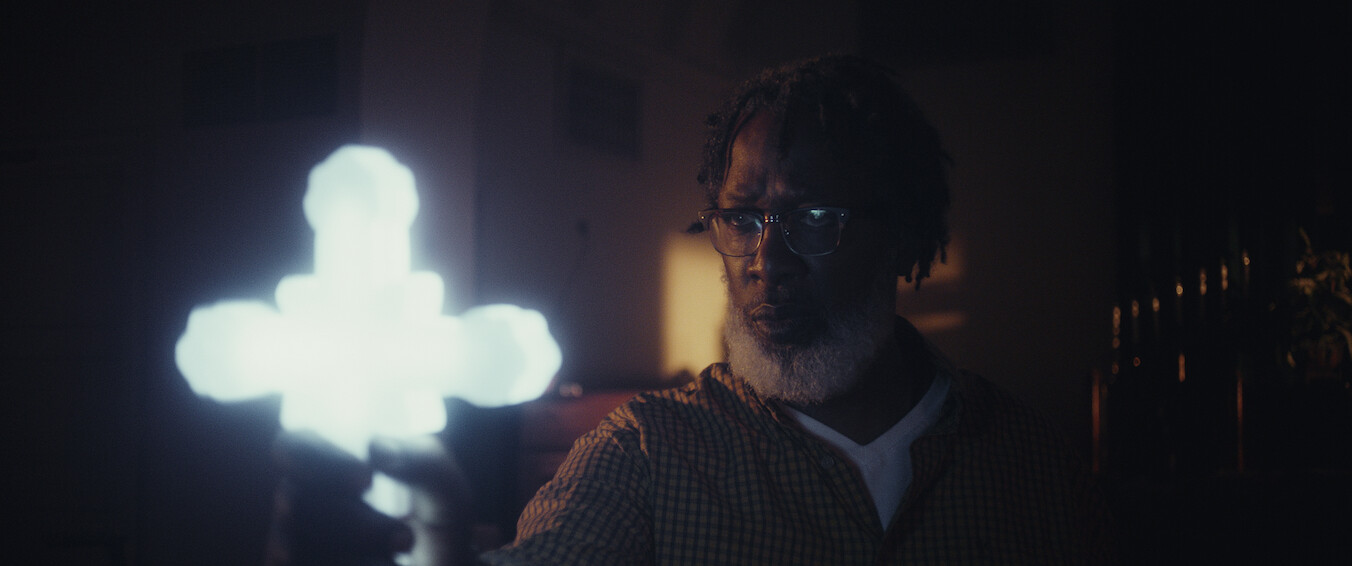
This vampire is old-school enough to scratch the folkloric itch. Lawrence shrinks from sunlight, hisses at crucifixes and holy water, makes thralls as he feeds, and travels with a Renfield stand-in: Christopher (Lance Gerard), Shadowbrook’s site manager, a lapdog who makes humiliation for mentorship. But LandLord takes tradition and bends it. The undead literalizes the metaphor we mutter under our breath of landlords as bloodsuckers—by owning the building and half the town. No invitation needed: when the deed is already in your name, you drift through thresholds like smoke. His “chicken coop” of tenants is an all-night buffet, protected by the steady cash drip that keeps Sheriff Connor (J. Barrett Cooper) looking the other way or worse, running interference.
And then, enter, the Bounty Hunter initially a mercenary with a price—finds something to lose. Abramson plays the shift small: sidelong glances, a hand that hovers a beat too long over a shoulder, a voice that softens by a note, then hardens again. Much like the Classic Noir pairings of the past with Detective pushed to the brink by a woman. Their scenes carry the film’s noir pulse—two people bound by circumstance, pacing out deals in hallways, exchanging clipped dialogue that cuts to subtext:
“ How much is a life?”
“ Depends who’s buying.”
“ Depends who’s selling.”
One of the film’s loveliest, saddest ideas is when the vampire Lawrence projecting 16 mm sunrises onto the walls of his darkened rooms, and even onto his own bare chest: a cinephile monster tattooing lost daybreaks on a body that can no longer feel them. It’s a flourish worthy of Carpenter’s fatalism and Kathryn Bigelow’s melancholy.
Lance Gerard’s Christopher is the film’s engine of tragedy, a man who does dirty work on the eternally deferred promise of a seat at the immortal table. In his more-or-less willing servitude to a white master he signs the form, fetches the body, mops up the blood. Connor, the sheriff, is the bridge between vampiric hunger and civic order; he cashes envelopes, tears up reports, keeps the invitations flowing.
For all its darkness LandLord plays clean as a genre picture: Predators thrive; the marginal is prey; institutions bless the harvest. Yet the film preserves space for decency not innocence, The Bounty Hunter’s arc isn’t redemption so much as recalibration: a predator who decides what she’ll no longer sell. When the end credits roll and yes, cheeky Special Thanks to Whoopi Goldberg and Ryan Gosling flash by.
Lean, mean, and pointed, LandLord is a strong, near-noir vamp thriller whose gunsmoke and clipped speech sharpen its social bite. Effective camera work in the walking scenes, bus scenes make it all worthwhile in the vogue of The Naked City with its actual location use and real people in some moments. Rounded it out with a stellar almost propulsive score again reminiscent of John Carpenter and his use of tones. The bounty hunter even smokes in classic Noir style. The monsters are real with fangs, badges, deeds and the only cure is daylight no one can afford.
LandLord screened as part of Grimmfest 2025.
 Bloody Flicks