


By Terry Sherwood
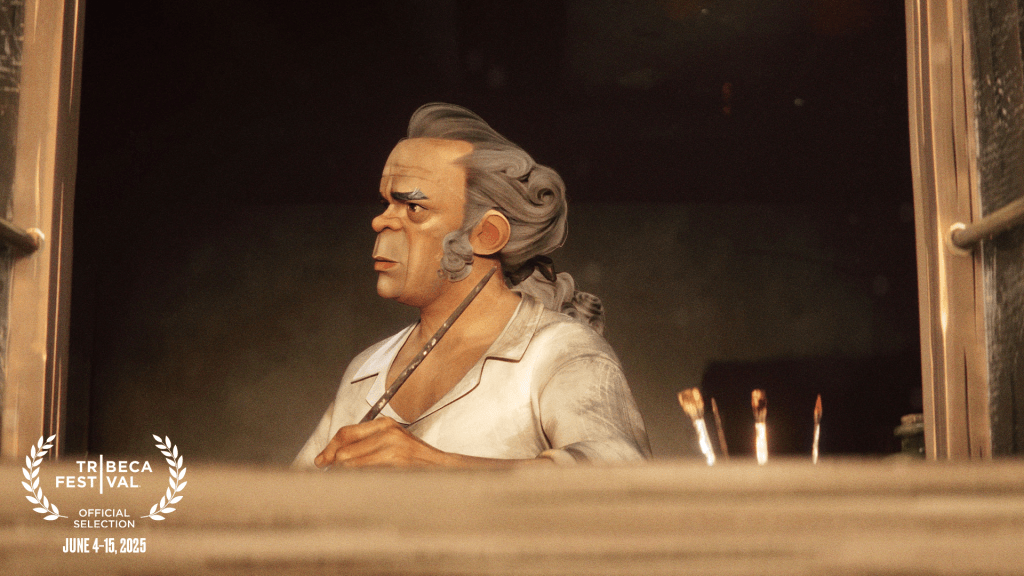
James A. Castillo’s The Quinta’s Ghost is an animated short that is a meditation on art, madness, and mortality, illustrated (no pun intended) though the final years of Spanish master artist Francisco de Goya. Castillo offers not a traditional cradle-to-grave survey but a descent into the very rooms where Goya wrestled with his demons. The result is both a haunted house story and a study of the artist’s soul, told superb animated visual intensity.
Bit of Art history lesson which I have interest that is good to more fully appreciate the work. The title refers La Quinta del Sord or “The House of the Deaf Man, which was the villa where Goya spent his last, reclusive years. Within its walls, he created what became known as the Black Paintings, a series of grotesque, terrifying visions painted directly onto plaster. These works remain among the some of the most disturbing. Castillo’s film imagines the villa itself as narrator, a structure that both shelters and imprisons the aging painter much like Rodrick Usher in Edgar Poe’s story The Fall of the House of Usher. To call it “The Quinta’s Ghost” is to suggest that the house carries the lingering specter of his creations.
Animation proves to a wonderful medium for this story. The film slips fluidly between reality and psychological nightmare, granting us direct access to the painter’s inner thoughts and torment. Shadows contort, paint smears across walls like blood, and figures emerge from darkness with startling force. There are clear echoes of horror cinema creaking corridors, looming silhouettes, distorted faces yet Castillo avoids cliché. Instead, he constructs an atmosphere where the line between inspiration and possession is blurred. In this sense, the film is as much a ghost story about the act of painting itself as it is about Goya’s personal hauntings.
The Quinta’s Ghost delves into isolation and the cost of creativity. Goya is shown as deaf, aging, and battling by illness, his world narrowing to the confines of the villa. Yet within that enclosure, brilliant of imagery takes place: Saturn devouring his son which is shown in a flash frame, witches, and beasts. The film suggests that Goya’s art was not a luxury but an exorcism—a means of survival against despair. Those familiar with the creative process will find this especially resonant. Any artist, writer, or composer who has confronted the blank page and the inner turmoil will recognize.
Art, Castillo implies, is less a choice than a haunting necessity.in a sense what brilliant American writer, the late Harlan Ellison once said the best writing is “Excavated”
The narration by the house itself is an inspired choice. Giving voice to the villa frames the story not only as Goya’s but also as the memory of a place that has absorbed centuries of grief and imagination. We are not only haunted by the dead but also by the spaces we inhabit, by the energy of a space we create in. Viewers who enjoy visiting galleries and contemplating the layered histories of objects and places will find this perspective to their liking moving. The film invites us to see a museum not as a sterile collection of works but as a place of anguish, joy, and obsession.
What distinguishes The Quinta’s Ghost from many festival shorts is its refusal to tidy up its vision. There is no pat moral lesson, no easy reassurance. Instead, we are left with an unsettling sense of unfinished business much like the Black Paintings themselves, which continue to elude complete interpretation two centuries later. The film asks whether genius is worth its price, and whether that price is borne only by the artist or also by those who live in the shadows of his visions.
Technically, the short film (Over 16 minutes) is superb. The animation layers textures that looking like brushstrokes, while sound design makes play the silence. The use of light and shadow channels both classical chiaroscuro and the uncanny language of modern horror. The film brings the traditions of painting, cinema, and folklore into a single experience.
The Quinta’s Ghost will reward patient viewers, particularly those with an interest in art history, the creative process, or the psychology of solitude. It is not a film for casual background watching; it demands attention, and contemplation. But for those who have lingered in front of a canvas in a gallery or viewed programing on The Museum Channel in North America and wondered what compelled a works creation, the film offers this moment. The Quinta’s Ghost is a moving reminder that “Great’ art is never merely made it is endured.
The Quinta’s Ghost screened as part of HollyShorts Film Festival 2025.
 Bloody Flicks