


By Terry Sherwood
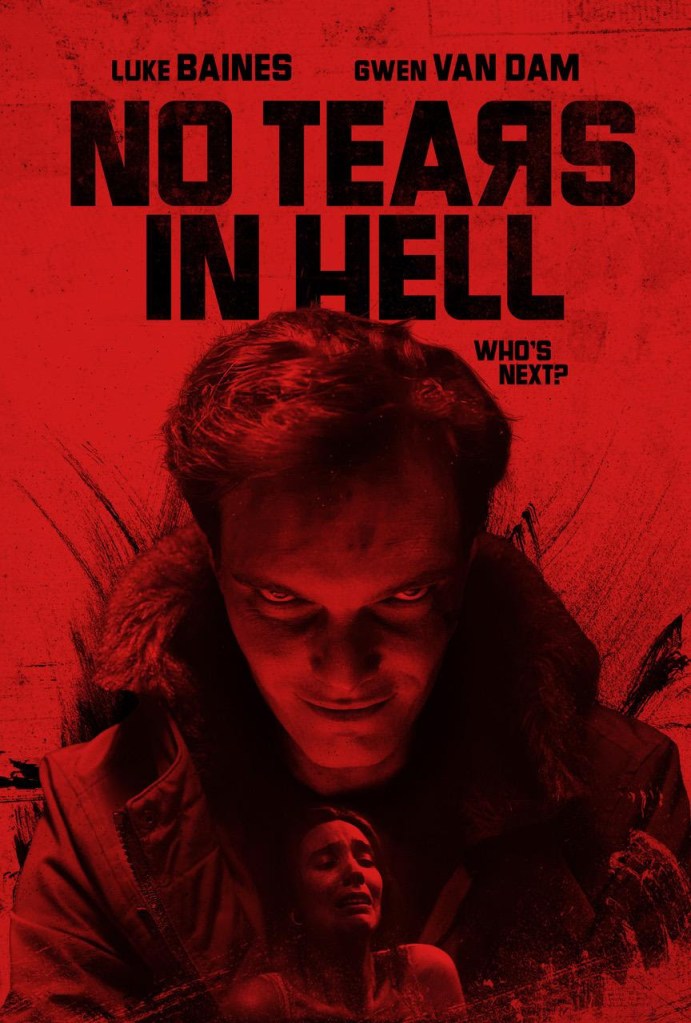
No Tears in Hell arrives with the full weight of its horror intentions unapologetically on display. Directed and co-written by Michael Caissie, the film adapts the chilling real-life case of Russian serial killer Alexander Spesivtsev—often dubbed the “Siberian Ripper” and brings it to the bleak, claustrophobic place of Alaska. It’s a film within frost, filth, shadows in the ‘Nordic noir” tradition and torment. And while it is technically competent with practical effects and committed to its disturbing material, one is left asking: to what end?
Luke Baines in the role of Spesivtsev, transformed into a gaunt, necrotic staring instrument of malice. Baines adopts not only the look of the real-life killer but channels a kind of emptiness and intellectual superiority in line with the book version of Patrick Bateman from Brett Easton Ellis’s American Psycho. In this picture he spills trivia about various killers in history, anecdotes about cannibalism along blood and body parts. The late Gwen Van Dam, whose portrayal of the killer’s domineering, complicit mother adds a domestic layer to the carnage.
The chill of the setting and the cast is both literal and emotional. Tatjana Marjanovic, Audrey Neal, Gabriella Westwood, and Erik Fellows round out the victims, playing their roles with varying degrees of vulnerability and terror, The sexuality is played safe almost in uncomfortable way bringing up the idea that you can cut up limbs, hear screams but you can’t show or won’t show Necrophilia. Either the theme becomes too much to show or film makers are not able to understand why or how to show it except in “video nasty” like 1987’s Nekromantik.
Director Michael Caissie, working from a story by Alexander Nistratov turns the story into relentless, near-pornographic gaze into pain punctuated by music. Moments of needles going in to perform lobotomy and even having one victim kill and enjoy the flesh as both Spesivtsev and his mother do seem are shown. No Tears in Hell belongs in the same grim lineage as Japan’s Guinea Pig and The Terrifier series or the more extreme entries in the New French Extremity movement. This is horror at its most confrontational what some might call “torture porn,” though that term often carries a flippancy. Still, one cannot help but question the utility of lingering so long on sequences of abuse, dismemberment, and despair. The commitment to verisimilitude is clear, but it becomes numbing. At times, the narrative seems to dissolve beneath the weight waiting for the next one
Is this a cinematic reckoning with evil—or simply an endurance test?
There is an argument to be made that horror, when dealing with real-life crimes, should be merciless. That to “look away” is to minimize suffering. But when brutality becomes the film’s defining feature, eclipsing even character or atmosphere, it risks undermining its own thesis. Scenes that should provoke reflection instead provoke withdrawal. The conversation becomes less about the film as a whole and more about that one scene, that one moment, that one violation.
That said, the film is not without merit. The sound design, in particular, works wonders by knowing when not to speak. The silences in No Tears in Hell are deafening, creating spaces where dread pools in the corners. Likewise, the direction is assured, with Caissie proving himself capable of evoking genuine tension amid the horror. But passion is not always the same as purpose. The question remains: what do we gain from staring into this abyss for nearly two hours? And why does the camera insist on holding that stare just a beat too long?
No Tears in Hell will find its audience among the horror faithful, particularly those who seek the raw, the real, and the repugnant. But for others, those who prefer horror that lingers through implication rather than mutilation may prove too much.
 Bloody Flicks