

By Mark Hockley
A love letter to giallo (Italian thrillers for the uninitiated) and director Dario Argento, with a score by original Goblin member Claudio Simonetti.
First, credit where it’s due: director and co-writer Daniel Lerner deserves genuine praise. So too does the entire production team. The ambition to craft a tribute to Argento is bold enough. But actually pulling it off and getting it in front of an audience, is a commendable feat in itself.
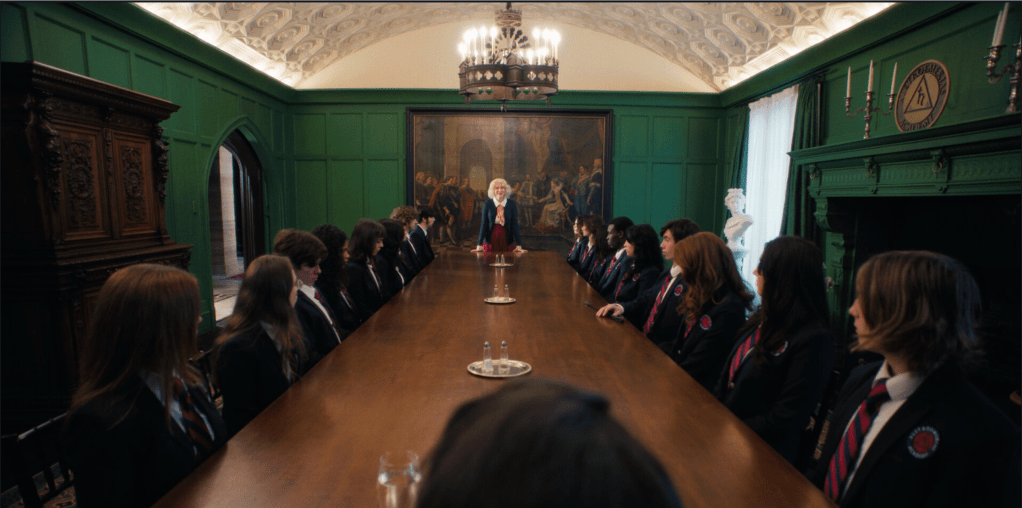
However, it’s at this point that I have to make some reluctant criticism. Let’s begin with pacing. The first half of the film, clocking in at 1hr 40mins, is pretty sluggish and to be honest, not a lot happens. After a striking prelude with a well staged death scene, there is too much talk and quite a bit of eating food at the dinner table!
Acting has never been the cornerstone of Argento’s own work and the same applies here. Sophia Anthony is a competent lead, while Velvet’s portrayal of the severe headmistress is borderline pantomime at times. But the success of this production was never going to rest on the strength of the performances. This is all about design, lighting and direction. It’s here that the film impresses.
Accepting that the budget was relatively low, to be able to capture the atmosphere and style of Argento’s early work is no small achievement. Bringing onboard Claudio Simonetti as composer is also an enormous plus. The band Goblin, of which Simonetti was a founding member, scored the Argento classic Suspiria. I think it’s fair to say that Simonetti’s later solo work has been variable. Argento’s Mother of Tears (2007) was sadly not a high point for either of them. Here though, his music is very welcome and eerily effective.
The story follows Miriam (Anthony), a newcomer at a boarding school presided over by a harsh and secretive headmistress (Velvet). The plot is hardly new or innovative. It merely serves as a framework for stylised stalk and kill by a masked murderer. And isn’t that what we are looking for when it comes to giallo!?
Argento’s filmography is a mixed bag and his more recent films are disappointing. I admire the early thrillers like The Bird with the Crystal Plumage (1970) and Deep Red (1975), but it’s Suspiria (1977) and especially Inferno (1980) that I hold in the highest regard. Saturnalia, in tone and aesthetic, aligns closely with those more baroque entries. Despite slow stretches and being rough around the edges, I appreciated what Lerner and his team achieved.
Saturnalia doesn’t hit every sinister note with perfect precision, but its nostalgic menace and commitment to the giallo spirit left me smiling.
Saturnalia screened as part of Raindance Film Festival 2025.
 Bloody Flicks