

By Simon Thompson
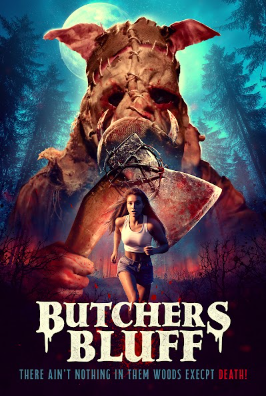
Directed by William Instone and Matt Rifley, and written by William Instone and Renfield Rasputin (which, credit is due where credit is due is an incredible pseudonym), Butcher’s Bluff is a gory and excessive – in every sense of the word – 1970s-1980s slasher movie throwback which I wanted to like far more than I sadly did. While Butcher’s Bluff looks fantastic; especially given it was made on what I imagine to be a pretty small budget, its flaws from a writing and tone perspective diminish its positive qualities to a sizeable extent.
The plot of Butcher’s Bluff follows a group of college students who travel to a fictional small town in Texas named Emerald Falls, to investigate an urban myth. While Emerald Falls appears to be your typical small town environment where everybody knows everybody, there is one little caveat – a shadowy mythical figure called the Hogman who haunts the town.
Although warned by the local sheriff ( Paul T. Taylor), and various other residents not to visit the Hogman’s domain in Butcher’s Bluff, the student main characters’ curiosity gets the better of them and they decide to see for themselves whether the Hogman is real or not.
Both Instone and Rifley’s direction as well as Instone and Rasputin’s script proudly wear their influences on their sleeve. Everything from the original Halloween and Texas Chainsaw Massacre, to Friday The 13th, to Deliverance and Eaten Alive is either specifically paid homage or displays a lingering influence in the narrative and visuals, through Instone and Rifely’s creatively gory kills and commendable use of practical effects.
The problem is that Butcher’s Bluff doesn’t really do anything new with its defined influences which renders the movie into a depressingly predictable viewing experience. In contrast to media such as Tiziano Sclavi’s Dylan Dog comics, the original Scream, or Edgar Wright’s Shaun Of The Dead, which all perform a tricky balancing act of both taking the piss out of, yet displaying affection for their influences, Butcher’s Bluff by contrast functions as a play by play of the various tropes and cliches of the slasher genre, but neither mocking nor doing anything new with them.
The biggest issue with Butchers Bluff above anything else, however, has got to be its pacing. Slasher movie classics like Halloween, were typically a lean and mean 90-95 minutes adhering to a perfect three act structure, whereas Butcher’s Bluff, on the other hand runs close to two hours and features far too many flashbacks and characters which heavily distract from the main plot.
The characterisation also falls flat, with all of the student characters being less three dimensional human beings and more like moronic walking bullseyes for the antagonist to pick off one by one.
The best acting in the movie by far comes in the shape of Paul T. Taylor as the town sheriff Joe (a character whose relationship to the Hogman within the narrative would’ve made the film far more interesting had he been the protagonist), and veteran character actor Bill Oberst Jr whose performance as local resident Jed steals the show every time he is on screen.
Butcher’s Bluff is available from 11 March on VOD platforms.
While the passion displayed by the filmmakers is truly wonderful to see, overall Butcher’s Bluff is a meandering and predictable affair which, in spite of some clever and creative kills and beautiful cinematography which fully makes use of its Texas shooting locations, its core premise is one that you’ve seen better executed a thousand times before.
 Bloody Flicks