


By Simon Thompson
Director Shunichi Nagasaki and writer Masako Bando’s Shikoku is a beautifully shot, yet dull and meandering mess that buries a perfectly good premise, a pretty interesting exploration of Shintoism, and some truly beautiful shooting locations, behind a glacially paced narrative. It’s the combination of the those three things that really made me want to like this movie far more than I actually did, but its narrative problems are far too glaring to be overlooked.
The plot of Shikoku follows Hinako ( Yui Natsukawa), a young woman returning to her rural childhood home years after moving to Tokyo with her family. After catching up with old friends and visiting various nostalgic haunts, she discovers that a close friend from her past, named Sayori ( Chiaki Kuriyama aka Gogo Yubari from Kill Bill), drowned at the age of 16. Sayori’s death has understandably driven her mother Teruko ( Toshie Negishi), a Shinto priestess, insane with grief, and after a few strange run ins in the night Hinako begins to suspect that Teruko is up to something.
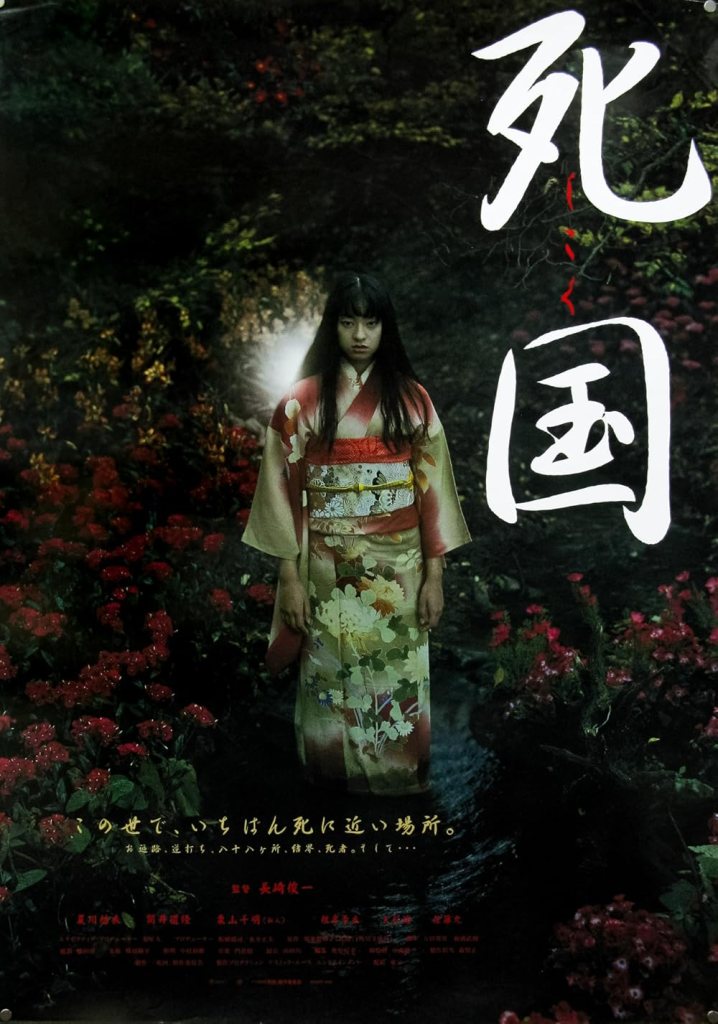
The cinematography of Shikoku is beautiful to look at. Cinematographer Noboru Sinoda contrasts the picturesque beauty of the town, with its various autumnal colours, with the ethereal, yet sinister, spirit world shot in dark blues and various states of shadow, giving the movie a striking visual palette.
As someone from a completely different cultural background I found the movie’s exploration of Shintoism to be fascinating, in particular with regard to how it looks at the concepts of death and the afterlife when compared with other religions. The problem is that the movie under explores this side of the story, which is a shame, because done properly it had a lot of potential to be something both thought provoking and dramatically interesting.
The acting in Shikoku is naturalistic and understated in keeping with the tone that Nagasaki is trying to establish. Yui Natsukawa gives a likeable and competent performance as Hinako, while Toshie Negishi captures the anguish of Teruko in a believable and unshowy way.
For all the things that this movie does do well however, it suffers terribly from its slow pacing. Despite being an hour and forty minutes roughly, its plot never seems to get off the ground, and although it does have a few genuinely chilling scenes here and there, it struggles to establish any real atmosphere or tension, in contrast to far better J-horror movies from around the same time, such as The Ring and Dark Water, which, in contrast, are both masterclasses in how you establish an uneasy atmosphere right away.
Overall, apart from some appealing visuals, Shikoku is a forgettable affair with limited re-watchability. Despite showing flashes of potential it frustratingly squanders a lot of its more interesting set-up just before the third act, making the last 30 minutes of it a chore to get through.
Shikoku is available now as part of Arrow Video’s J-Horror Rising boxset.
 Bloody Flicks