


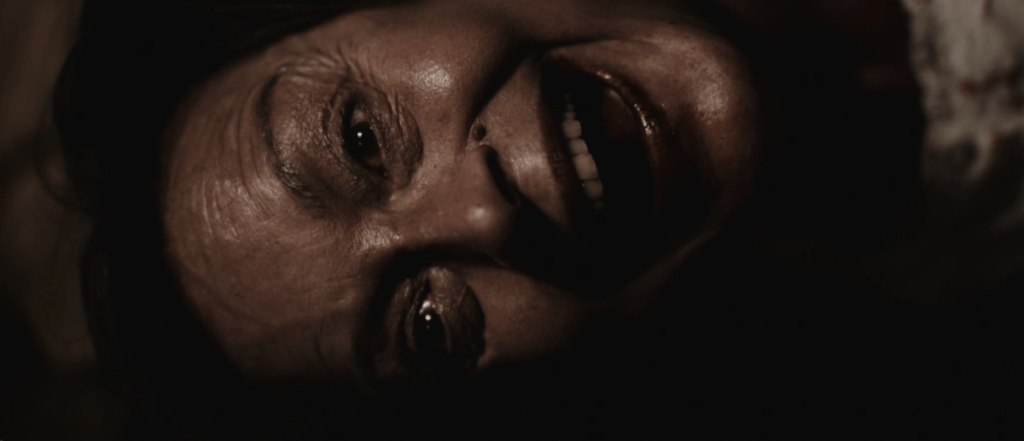
By Terry Sherwood
Genre Films that advertise themselves as groundbreaking often are not or simply give you a more extreme version of what was previously done. With eleganza, Written and directed by Italian Daniele Campea who with a background in Cinema, Opera, theatre and video art presents us with one of most enigmatic, subtle, erotic studies of madness in the form of Mother Nocturna or the Italian Madre Notturna
From the home of Frederico Fellini, Michelangelo Antonioni, Sophia Loren, Claudia Cardinale, Marcello Mastrianni, Vitorio Gassman and so many others oozes drama about isolation, female rage, and infanticide. Photographed and directed sometimes too stylistically in the moonlight and with a powdering of folkloric imagery, the film takes viewers to a dark place as it illustrates a grieving mother’s slow spiral into madness concerning the death of a child and other things. The theme of Mother Nocturna is not new it is the artistic execution, from character to music that makes this a tragedy.
Susanna Costaglione plays Agnese, a biologist, mother and Wolf expert who is ending her stay at a psychiatric hospital. Edoardo Oliva in the role of her husband, Riccardo, is a medical doctor who warmly welcomes his wife back home Arrianna their daughter played by Sofia Ponente attends ballet classes which turn out to be the only time she comes alive. Melancholy, mysterious, and short-tempered with men her age Arrianna unleashes withering contorting, sexual without being overt force of nature dance performance. There is something within the woman that is expressed in the movement and the music that spills out like a blast of champagne when shaken. Arianna isn’t as happy as her father about her mother’s release expressing concern that her mother’s psychosis will only return in full force.
Agnese begins displaying odd behavior, connected to the moon and the wolves that she studies for her new upcoming book Riccardo is quarantined after testing positive for a virus which is the time this film is set , Agnese and Arianna find themselves trapped in their house together to face the ever-deepening rifts This crumbling mother/daughter relationship reveals itself in moments of familial jealousy, and female rage as represented by a set of familiar imagery of the wolf, eating of flesh from a fridge and dreams of a woodland creature
Agnese, Ricardo, and Arianna are each hiding something, that will reveal concealing their true selves to each other. The visual darkness and obscurity enhance this with a superb sound score employing whistling winds, ringing, and low-droning noises along with traditionally orchestrated works. The sense of isolation that brings a type of madness brings time mind the work of Joy Division who were known to employ screams and the sounds of breaking glass in some of their recording. The perpetual darkness is broken only by sterile-looking day moments and Arrianna’s dance moments plus the viewer in towards the shattered climax.
Castwise, Susanna Costaglione gives a strong, steady, performance acting as the locus point in which the other family members revolve around. Subtle moments, like wishing to die yet not inhaling cigarette after cigarette, becoming incredibly dirty with earth after a dream, and tired beyond comprehension as the secrets inside slowly digest her. Edoardo Oliva in the role of Riccardo her husband is the steadfast Doctor, yet rather cold in terms of family life. He dispenses his treatments with clinical precision in precise language over the phone. He even tries to deflect an accusation of a romantic liaison with a patient or fellow doctor when hinted at during a phone call by the suspicious Agnese who accepts it as part of life and her torture. Agnese and him both try to try to make their relationship like the past when they were first married only to find the memories hollow.
Sofia Ponente as the teenage daughter Arriana is simply both physical in terms of dance and her appearance in this film a stunning screen presence in the great tradition of Italian raven-haired women of the screen. Smoldering looks in the dark with her long hair, rebuffing a potential boyfriend at dance school, to confront her parents with demanding incisive dialogue. Arrianna is complex, as she deals with a quest to know the truth about her family being treated as a child yet being an unmistakable physical woman. In one moment not done rudely or gratuitously, Arriana is enraged by her father’s behavior, she storms around the home followed by her imploring father to her room when she takes off her shirt showing quite obviously that she is not a child anymore. Riccardo shockingly turns away saying he will wait outside The dark, the clothes, the eyes, and the movements to her nonchalance while dancing to suddenly stop in mid-stretch to answer her phone is a reminder of Brigitte Bardot’s famous photograph of her sitting open-legged playing solitaire. Confidence, eroticism and feminine beauty all in one moment.
Mother Nocturna or Madre Notturna is a captivating, cynical exercise in family secrets, parenting and how isolation in both society and certain occupations that can insulate and release can become obsessions without dealing with the real problem too horrible to consider.
Mother Nocturna is now available on VOD platforms.
 Bloody Flicks