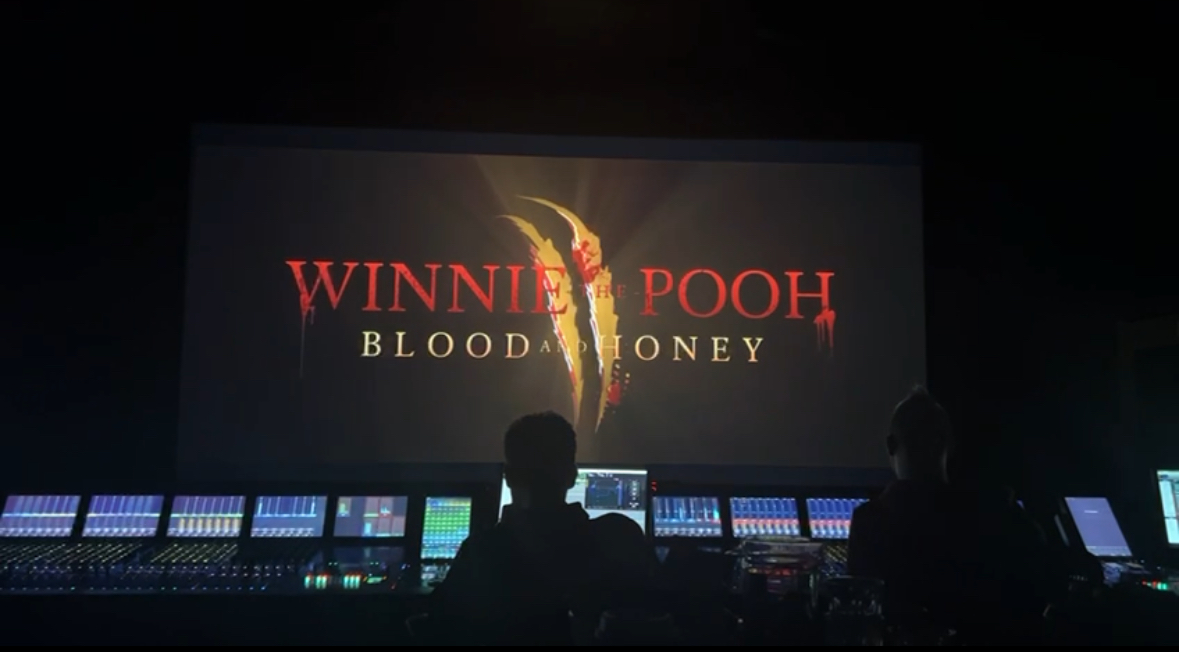

After the recent release of the Winnie the Pooh: Blood and Honey sequel, it looks like the Poohniverse is the next big indie horror project.
With movies based around the fairytales of Peter Pan and Bambi plus more Winnie the Pooh on the way, there’s plenty for horror fans to sink their teeth into.
We caught up with Sound Designer Ryan Hatton to talk all about his involvement in the Poohniverse and beyond.
How did you get started in sound design?
My journey into sound design began when I first heard the seismic charge of Slave 1 in *Star Wars: Attack of the Clones*. That was also the first time I experienced something so grand on my Dad’s 5.1 audio system in our living room. It was a defining moment.
Following this, like many sound designers, I developed a love for music and playing instruments. This naturally led me to record myself and my friends. While studying at university with aspirations of becoming a music producer, I took a sound design module. It was there that I gained a much deeper understanding of the craft and realised my true passion was in recording and creating sound for linear media.
I created a showreel by redesigning sound for video game clips from scratch—endlessly tweaking and refining them. This eventually led to free or low-paid sound editing jobs for students and low- budget productions. Over time, this hard work snowballed into a full-time sound designer role, where I handled everything from dialogue editing to mixing and basic sound design.
Why do you think sound design is so important, especially in horror?**
Sound is an incredibly powerful tool in film, though it’s sometimes overlooked. In horror, however, it’s one of the most critical elements that shapes the viewer’s experience.
Film is all about storytelling, and sound plays a crucial role in that narrative. In horror, sound is especially vital as a dynamic storytelling tool. Not only can it create the unsettling gore sounds that make audiences wince, but it also allows for the exploration of non-diegetic sound (sound intended for the audience, not the characters). This can build unbearable suspense leading to a jump scare—or even a false one (my personal favourite)—through expertly crafted sound design. Techniques like chilling low-end drones and sudden, loud impacts are just a few examples.
When analysing a scene, I constantly consider the emotions of the characters and how I can convey those feelings to the audience through sound. Horror is one of the more interactive genres in film; if everything is done correctly, the audience should be fully immersed in the world, both visually and sonically.
You started off in documentaries. Was it always your intention to move into feature films?
A part of me always dreamed of working on feature films, especially in a genre as fun as horror!
While working on documentaries at Playsports Network, the COVID-19 pandemic hit, forcing me to work from home during lockdown. With the newfound time at my home studio, I decided to explore something new. I applied for a sound designer role on a low-budget horror feature via Mandy.com, and to my surprise, they took a chance on me. Transitioning from documentaries to feature films was a steep learning curve, but I had the luxury of time to really hone my craft, and I tapped into the wealth of knowledge available online.
This experience led to more projects from the same company, and soon, opportunities with other production companies followed.
What can you recall about the initial conversations regarding the Poohniverse?
I knew that Jagged Edge was filming Blood and Honey, but at that time, I wasn’t attached to the project. After pitching some ideas and throwing my hat in the ring, Rhys and Scott welcomed me to supervise the sound for their upcoming slasher film.
Interestingly, I was on vacation when the news about the film began surfacing. I was immediately captivated by the overwhelming interest in the project, which made me realise that this was going to be much bigger than any of us had initially thought.
The growing pressure drove us all to give it our all, especially considering the time and budget constraints. Our goal was clear: create a gory slasher. I drew inspiration from films like The Texas Chainsaw Massacre and Scream. It was crucial to lean heavily into the shock factor and show the audience that this wasn’t the silly old bear they grew up with.
I spent considerable time experimenting with gruesome gore sounds, using different textures and frequencies, and recording bespoke sounds to craft a brutal and violent soundscape. The dynamic mix we achieved ensured that every fearful breath could be heard during the quiet moments, and the loud moments would keep the audience on the edge of their seats. The mixing process, crucial in audio post-production, brought the sound and story to life—not just in horror, but in all film genres.
The future of the Poohniverse hinged on the success of Blood and Honey, and thankfully, the film performed exceptionally well relative to its original budget. I’m grateful to continue as the supervising sound editor on this franchise.
Were you surprised by how much things took off after *Blood and Honey?
Absolutely, I couldn’t have predicted how quickly things would take off after Blood and Honey.
For me personally, it opened many doors that would normally be out of reach. Working on a project like this and seeing it through to a theatrical mix played worldwide is a significant milestone. It’s also a great conversation starter within the industry.
I’m incredibly proud of everyone involved, especially considering our limitations with time and budget. Overall, I think we did a fantastic job!
What did you learn from the first film that you applied to the sequel and beyond?
Working on Blood and Honey and experiencing it in a large cinema gave me a deeper understanding of the complexities of theatrical mixing. It taught me how far I could push the mix in terms of aggression and loudness, while also bringing out the quiet subtleties.
After Blood and Honey had succeeded, I was hired by Lightyear Studios in London. They specialise in ADR, sound design, and mixing for various projects, making it a perfect fit. Lightyear has an incredible Dolby Atmos studio, which we’ve used extensively for mixing, ADR, podcasts, and sound design.
When asked to work on Blood and Honey 2, we knew we wanted to make full use of Lightyear’s facilities. With a small team dedicated to different elements of the film (dialogue, ambiences, foley, etc.), I had more time to focus on sound editing and design, exploring the soundscape in greater depth.
With the addition of a larger team, we were able to record bespoke foley in the studio, including footsteps, cloth movements and props. Foley is the aural spine of any film and is often overlooked. We were also fortunate to complete the final mix at Pinewood Studios, allowing us to fine-tune the mix for optimal performance in theatres worldwide.
What feedback did Scott and Rhys give you on Blood and Honey that you took into the next films?
LOUDER.
Rhys and Scott emphasised that they wanted their films to be loud and impactful in theatres. We aimed for a mix where the music jumps out and the gory impacts are felt viscerally.
During the mix stage, it’s essential to balance loud and quiet sounds. If the film is constantly loud with no dynamics, it loses its impact. We made sure to incorporate dynamic moments in the audio mix, ensuring the audience experiences every detail as we intended.
Both Rhys and Scott are extremely passionate about their work. We spent considerable time in the studio together, meticulously combing through every detail and exploring new ways to enhance each scene. This level of dedication and attention to detail is something I’ve carried with me on every project to elevate the experience.
What can you tell us about the upcoming Peter Pan and Bambi entries to the Poohniverse?
As I write this, we’re about to enter the final stages of the mix for Peter Pan (the trailer is live!), and we’ll immediately begin work on Bambi afterwards. Busy times indeed!
Peter Pan has a much darker tone than Blood and Honey and brings its own uniqueness and flair, which I’m confident audiences will love. We’ve been experimenting with some intriguing sound design for this film, so it’s definitely one to watch in theatres.
I’ve seen some early VFX clips of Bambi, and they look amazing. Given the budget constraints, director Dan Allen has done an incredible job managing the VFX and utilising various lighting and shot techniques to achieve an impressive look.
Watch out for the next chapters in the Twisted Childhood Universe!
Winnie the Pooh: Blood and Honey 1 and 2, are available now on DVD & Blu-Ray.
 Bloody Flicks