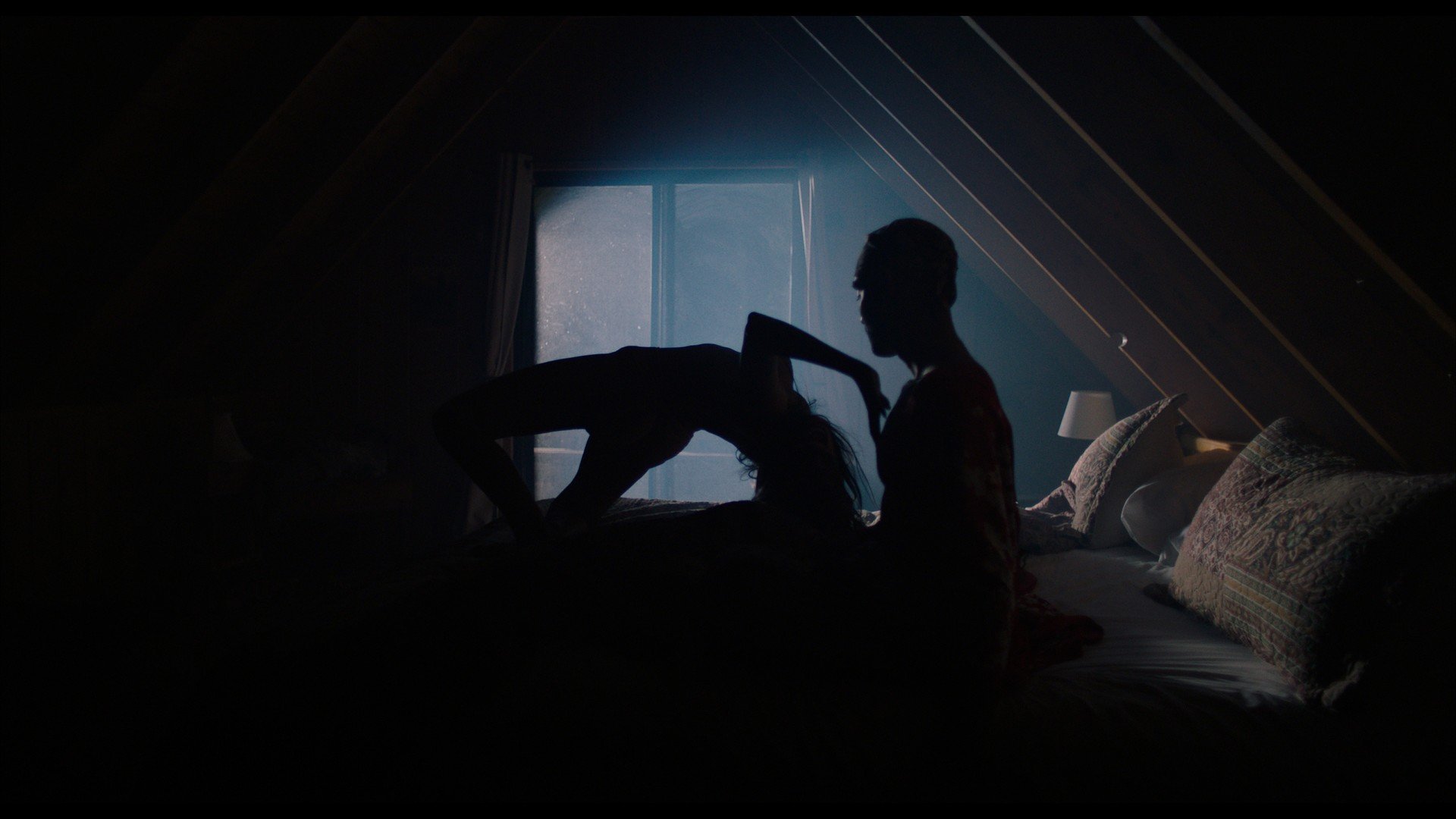

Outfest got underway yesterday, and we managed to catch up with writer/director Blaine Morris to discuss the horror short The Ciguapa.
What can you tell us about the folklore behind The Ciguapa?
The Ciguapa is a Dominican folklore creature I came upon when doing research on Latin American mythologies to find inspiration for films. A version of the Ciguapa, a beautiful woman who lures men to their death, comes up in many cultures similar to sirens or mermaids. I was excited to find a version in Latin American folklore that has its own distinct characteristics of long black hair, backward feet, and a bewitching stare while being familiar enough for broader audiences.
What made you decide to adapt this into a short film?
I love genre films, and I was frustrated that for Latiné people, who make up 27% of US box office goers, we were getting the same stories or the first people being killed off. I believe two films on La Llorona came out in the same year, often with white protagonists. There are so many rich Latin American folklore mythologies waiting to be explored in cinema. My friend Alexander Flores, producer and Manny in The Ciguapa, were in a frustrated pandemic rut and wanted to create a film that we haven’t seen before; queer Latiné people encountering a culturally specific monster in the horror space. It’s a classic cabin in the woods story but reinvented, refreshed and one that seemed like a great space to create a short film.
How important was it to have a queer perspective in this film?
I’m a bisexual woman, and as they say, it’s better to write what you know. There is very little bisexual representation in film. I wanted to bring my experiences of dating in the queer community to the screen while doing it through a genre lens. Queer people are usually the first people killed off in horror, so I wanted to make a film where we were the leads and not used to forward other people’s character arcs. Often for bisexual people, there is a stigma against us in the queer community. In film, we’re portrayed as greedy or unpredictable vixens. I wanted to create a story closer to my lived experiences where I sometimes have been made to feel unwelcome or not enough in queer spaces. I also wanted to create a queer film that’s not focused on trauma, first love or coming out. It’s a realistic queer relationship where people get to be people, who just happen to be in a queer relationship, experiencing the universal growing pains of a relationship as they start to take their next steps.
Tell us about the genesis of Hex the Patriarchy?
Hex the Patriarchy comes from the wonderful minds of Heather Muriel Nguyễn, Anne Brashier, and Xan Churchwell, who I went to USC with. They brought me on as the first assistant director, and once I read the script, I immediately asked to edit the project. I’m always looking to work with other queer and femme collaborators and finding other like-minded people who love creating genre content with a twist seemed like a great collaboration.
The story is funny, witchy and queer while tackling the bullying of queer youth. You really cheer for the main characters, and it was such a delight to make a joyful queer film. During the editing process, they really let me bring forward my ideas and get weird with the spellcraft sequence. I also love editing comedy, and seeing the crowds during the Outfest Fusion Gala laughing in delight was a moment I’ll hold on to for a while. I can’t wait to see the reactions of the Outfest audiences.
How pivotal is it that we look at stories about bullying and their consequences?
The Human Rights Campaign just announced a National Emergency for LGBTQIA+ people. There are currently hundreds of discriminatory legislations in the courts and being passed. Through the news, it is hard to contextualize the very real people this will affect and the communities this empowers to continue bullying and committing violence against queer people. The power of filmmaking is its ability to create empathy. People in middle America may not have even met the people they proclaim to hate, but through films, we are able to introduce so many different backgrounds and cultures to a wider audience to start a conversation about acceptance.
Is the film played (forgive the phrase) straight or more tongue-in-cheek?
Hex the Patriarchy is a queer witchy comedy with realistic stakes. These queer friends are being bullied in school, and to stop the bullies, they decide to cast a spell since one of them happens to be a witch. Through the comedy, the film explores that we should let people find the terms and identities that bring them the most joy while keeping audiences laughing. Taking the small step to address someone how they’d like to be addressed can make a difference in someone’s life. This film has a wonderful happy ending where our heroes succeed, which leaves you hopeful for a more understanding future.
What does it mean to be screening both films at Outfest?
It’s very exciting to see my work receive any recognition. I spent the last three years in graduate school at USC and worked on tons of films. To have these films leave the school space and find broader audiences is what any filmmaker wants. I make films to entertain and make people think, and to find festivals that resonate with my ethos as a queer, feminist genre-focused filmmaker is such a joy.
How positive is it that we are seeing more queer voices in horror?
I would say five years ago, there really weren’t any, so to be in a block at Outfest with all queer horror movies is very exciting. Historically, queer people in horror were either coded, the monsters or a side character killed off first. To have queer voices centering queer characters in the genre is basically a new frontier, and I can’t wait to see what compelling new stories are created.
Are you working on more horror films soon?
Currently, I’m working on the feature version of The Ciguapa, which focuses on a queer couple, a straight couple, and a non-binary person on a cabin trip with a feminist twist as they encounter the Cigaupa. Later this year, I have my psychological thriller feature Dark Obsession which I wrote, produced and starred in, featuring Mena Suvari and Adriana Barrazza, coming out. I am also working on a Mexican border feature where vampires come from Aztec mythology.
Find out more about The Ciguapa at Outfest 2023.
 Bloody Flicks