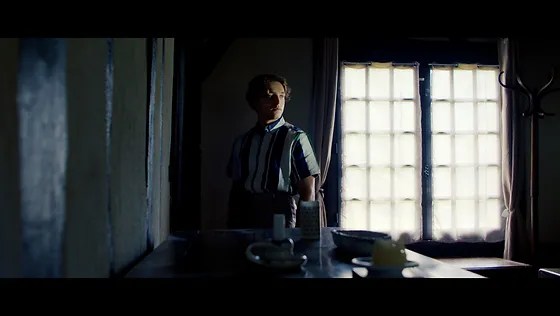

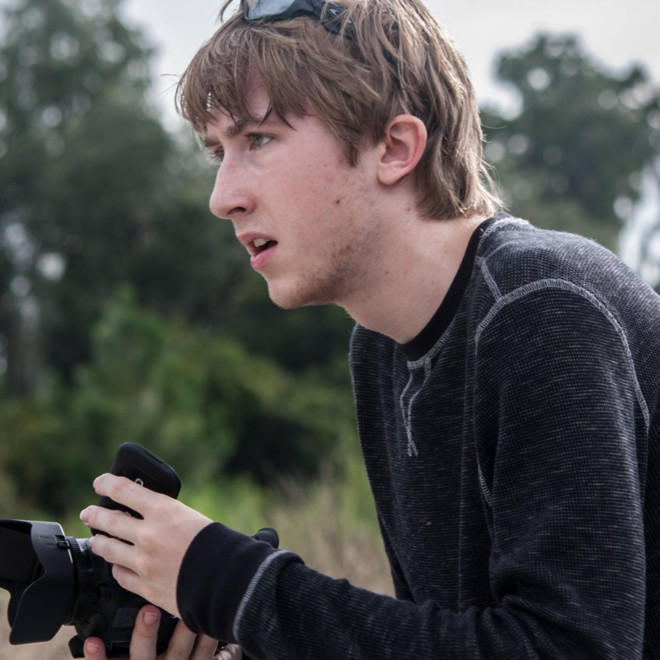
Ahead of the Sohome Horror Film Festival: Pride Edition we caught up with writer/director Will Stead about his WWII vamp horror Children of the Night.
Can you tell us how the concept of Children of the Night came about?
Children of the Night really is a culmination of the genres I have loved since I began my filmmaking journey at 9 years old. In the early days, the Hammer Films of the 1950s and 60s really captured my imagination, the vivid colors, the quiet moody buildup culminating in a bombastic finale. The Christopher Lee Dracula films specifically had always been on my radar to tribute even as I was finding my filmmaking voice through my teens and now early twenties. When Ace Entertainment and Dark Temple Motion Pictures approached me to write and direct a genre heavy project, I saw it as an opportunity to almost fulfil a childhood dream. The only difference now is I have found my niche in telling historical Gay drama films. My previous project, All the Young Dudes, was a queer glam rock coming of age drama set in the 1970s. Long story short, I thought it would be creatively fulfilling to write what I knew. A historical gay drama with a Hammer Horror twist to it. And that’s really where the concept began.
Was it always your vision to shoot this during World War II?
The World War II backdrop always kind of came with the project for me. During brainstorming of what I wanted to do for the film, I had a dream of seeing a red cloaked figure in a Second World War era trench, surrounded by smoke and bodies with the soundtrack of Franz Schubert’s Trio In E Flat, Op. 100 playing. Everything else was built around that. This exact image from my dream is in the final film. Schubert’s piece has always been synonymous with vampires for me, as it provided the soundscape to Tony Scott’s 1983 film, The Hunger. It can be extremely difficult for low budget films to do historical right, but I find World War II is one of the easier periods to portray on a budget. Fields and Norman architecture still exist, so I find it simpler than doing, say, the 70s where you need to dress civilisation, cars, buildings, people. From that aspect, I think the War backdrop fit the scope and budget perfectly, and shooting on location in Normandy was there from the start. There really is no substitute for that area of France. The one thing I really wanted to make sure of was not to make the Nazis the Vampires. To me, Nazis can’t get any more evil than they already were, and so to have the Nazis against both our hero and the vampires was incredibly important to me and I think a somewhat unexpected subversion, especially with a lot of nazi-creature related media out there right now.
How challenging did you find it to blend what is essentially a war love story with some more horrific elements?
A through line that all my movies have is a character with internal conflict. In this case Jim is wrestling with his past, being forced away for expressing his feelings for another man, and moving into the war not really knowing who he is. For me, that’s the core of the film and it doesn’t really matter what situation you put that in. The film could very easily be a drama without the horror elements, but putting a character with emotional struggle, feeling somewhat inhuman and outcast himself in this very fantastical situation among fellow outcasts and monsters, just seemed very fitting. I think it’s fun to blur the lines of genre, and it’s fun for an audience too. As well as the idea of representing gay characters onscreen, the main takeaway I want from this film is for people to just have fun with it. To expect one thing and be shown something completely different.
Can you tell us how Dark Temple Motion Pictures joined the project?
In the beginning of 2022, I had just moved to the UK from Florida and had kind of lost my way in filmmaking. I didn’t really know what to do and so I found myself working at a gay bar. I had known Charlie Steeds, head of Dark Temple, through Instagram and one day he messaged me explaining his plan to expand what his company is. Prior to this film, Charlie had directed every Dark Temple movie and so he now wanted other filmmakers to take the reins. He came on board as producer/ DP and gave me full creative freedom to make both a film I had a vision for and a film that fit into his indie horror brand that he’s spent the last decade building. I was able to quit my job at the gar bar and move full-time into bringing Children of the Night to life. Now Charlie and I have a very good working relationship. On top of directing this film for Dark Temple, I am now in the process of editing two films that Charlie has directed. I hope to continue contributing to the indie horror scene of the UK.
You have a few familiar faces to UK indie horror fans, how important is casting for these sorts of films?
I was very lucky to have a cast that took the material so seriously. The key in these fantastical concepts is to build a world where everyone believes in it. We were a fairly young cast and crew, and to have the amazing Johnny Vivash bring his professionalism and experience to the set every day was a blessing for everyone. The man is in love with his craft and it truly excites me as a director to watch him perform and immerse himself into the world. It was a very comforting experience, especially with this production being my first full-feature film. We were all staying in the same house for 2 weeks so after hours we all got on like it was summer camp. Having barbecues, drinking, and seeing the local sights. In these small guerrilla films, building a family is so important because we are all there at the same level in love with what we do. There’s no room for divas or anything like that. We muck in and have fun. Great people as well as exceptional performers.
Without spoilers, what was your favourite sequence to put together?
My favourite sequence to shoot was the opening actually. We saved the most fun day until last in our schedule. Morale was at its height. We spent the whole day running around a period-accurate trench in full war uniforms. Its what you dream about when you’re a kid. We only had three soldiers so it was entertaining blocking actors to make it seem like there were way more than that. I was off-camera throwing stones at my actors making it seem like bullets were flying. Movie magic indeed.
The film receives its UK premiere at the Sohome Horror Film Festival soon, how exciting is this?
For me, the fact this festival is a celebration of queer stories onscreen is so important. I’m ecstatic that my first feature film opens such a great festival that highlights so many stories you rarely see. Our voices are loud and beautiful and this festival celebrates that with a macabre twist. Those who love genre-heavy cinema have found their people with the Sohome Horror Film Festival.
What is your next project?
I am working towards adapting my short, All the Young Dudes, into a full length feature. Its no easy challenge so it’ll happen over the next few years. It’s a glam rock coming of age film, set in rural 1970s America with a romping David Bowie soundtrack. I think people are really going to dig it when they see it.
Catch Children of the Night at Sohome Horror Film Festival: Pride Edition.
 Bloody Flicks