

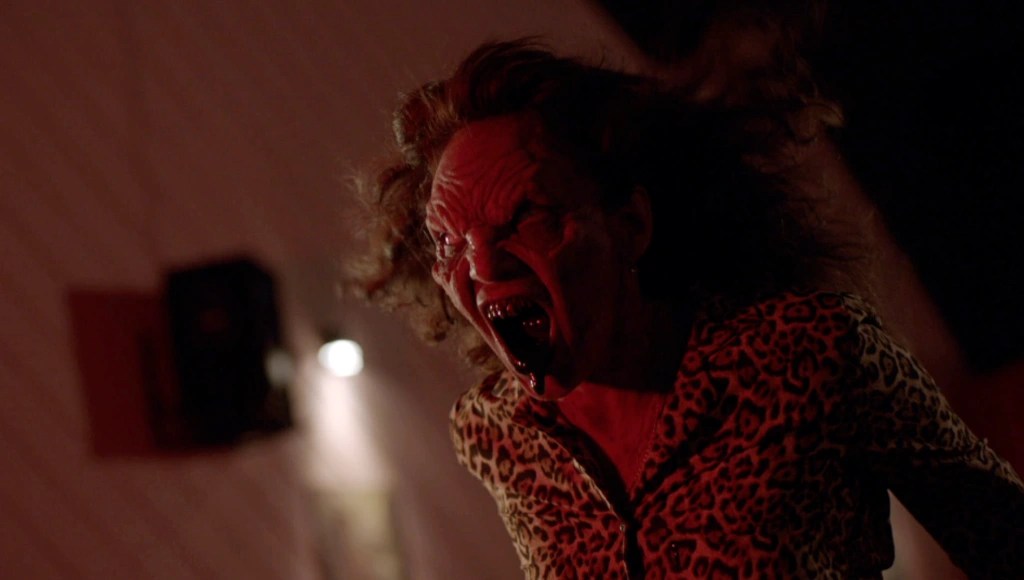
Following its screening recently at Fantasia Festival, we caught up with filmmaker Fabian Fortes to discuss horror fantasy Legions.
Tell us about the writing process for Legions?
It was a process of many years. The idea of a shaman trying to recover his daughter who lost her faith because of the darkness that persecutes her clan, really appealed to me. As a story and as a metaphor. I clearly had the premise in mind but developing it into a feature film script took several years. I had a first version of the script in 2017, but as the production processes were taking shape, I was correcting and adapting the script. There were various versions and characters that were disappearing, as well as others that were adapted. Certain concepts, locations and scenes were also reworked on paper. At the time of filming I always try to have the best possible version of the script, with even the dialogues already worked out in rehearsals with the actors.
How did this compare to your previous directorial work?
Sometimes they ask me what my style is, comparing my other works. And I always answer the following… that my style is to adapt to the shooting times that I have to meet and that they are always based on the budget we have to make the film. In other words, I don’t think I have a form, a style, I do think I have a cinematographic narrative in which I am very aware of the production.
In this case, I will add to this answer that by comparing this film with The Dead Man Tells His Story or with fragments of Damn They Are!, that my films always have humorous aspects that are established in the script. Terror, the fantastic and a certain irony or comedy is something I like to work on in my works.
This appears to be quite the outlandish story, how did you manage the look of the film while staying within a budget?
Basically I tried to be very aware when writing the script of what things were possible to do and what not. I am convinced that my experience as an assistant director in other films has given me a job and flight hours on sets, so I am aware that what I write can be filmed. Nothing very extravagant that cannot be produced, always speaking of our local industry. Having a conscious and coherent script of our budget (support INCAA) is an important step to survive our Argentine film industry and to be able to make a movie.
I add that I was accompanied by a production company (Coruya cinema) that defended the film very much and that I had a great technical team behind the camera that was able to solve the challenges that the script contained. Each area articulated ways to specify what was necessary to be able to carry out the film. Having a good, resolute and creative team is essential to achieve the desired result.
What can you tell us about the casting process?
At the time of writing the script, I was already thinking about German de Silva for my protagonist, with whom I had worked on other films. Finally I was lucky enough to be able to count on him for the role of Antonio Poyju. German naturally has a certainty and truth in playing a character that Antonio should have. Antonio’s poise is one of his most notorious characteristics, his confidence in himself and in his origins. It was essential for the viewer to connect with the story and believe in Antonio, the truth that German transmits.
In the case of Lorena Vega (Helena) or Moro Anghileri (Clara), they are actresses that I admire and who have been with me for many years in other projects. They were the ones indicated not only because of the character of the characters, but also because of their physical appearance and the job they both have. For these characters I didn’t have to do castings. I can tell you the same about Antonio’s fellow boarders. Demian Salomon is a fetish actor of mine, I always count on him because he seems fantastic to me. Mauro Altschuler and Marta Haller had seen them in theater and I knew when I saw them that they were the ones.
Specifically, I did casting for some characters like Warren (Ezequiel Rodriguez) or for young Antonio and young Helena. Since the past of the characters takes place in the jungle, we had a casting team in Misiones that looked for the actors for these roles. We made these 17 minutes (I think) of narration that take place in the missionary jungle a year after the rest of the film, because the pandemic stopped us. It gave us time to find these actors who must have similarities with German / Antonio and Helena / Lorena.
Tell us about the atmosphere on-set, was this a feel-good shoot?
It was a wonderful shoot. But I will try to divide the filming into two stages because that is how it happened. Buenos Aires stage and Misiones stage. The shooting had a very strong planning, where nothing happened out of the planned. The film has its stakes and fantastic cinema deserves to be very methodical if you have to work with vfx and control the post production budget. Many effects, many complex scenes to perform that take time to shoot due to having various shots, characters with a strong characterization work on set, protein make-up, night scenes, low light keys for Kuarahya’s domain, in short, various issues and four weeks to achieve a 90-page script.
We added a second unit directed by Demian Rugna to achieve all the scenes that the plan required, for which there was a week that we had two units working in the same location that had the right space to be able to recreate the scenes and to be able to achieve that both Units coexist and work in unison. And we were able to do it, since the location was large and had several floors. Scouting work is essential to find the right location and fulfill the task.
The two Misiones stage, where the missionary production company Montecine joined the production company Coruya Cine as co-producer, happened a year later (end of 2020) and had the drawbacks of the pandemic. There were certain limitations that we had to live with. But that did not stop it from being a fun shoot full of camaraderie and love for the story we told.
The film recently screened at Fantasia Festival, what was that experience like?
Fantasia is an excellent festival, and they have been very attentive with our film. It is a great honor for us to be part of your programming. Like any great festival, it is a huge showcase for the film and it was its premiere in North America. Legions reached a ton of people and garnered a lot of attention and mixed reviews. That it reaches the mass public and lovers of the genre is a wonderful moment. And hand in hand with Fantasia, a joy.
Previously, the film premiered in Fantaspoa (Porto Alegre, Brazil) where I was able to accompany the film personally and live the experience with the public.
Is the plan to feature in more film festivals around the world soon?
Of course, our plan (of Javier Diaz producer and myself) with Filmsharks is to continue showing the film internationally in other festivals soon. I understand that there are already commitments made with festivals that are very representative of the genre.
At the same time we are very excited for the soon distribution that XYZ will make of Legions.
In Argentina we believe that it will be released near the end of the year.
 Bloody Flicks